|
|
Reading and Thinking: Climate Change Requires World Attention文本简析
本单元阅读文本的话题是“健康的生活方式”,旨在帮助学生认识习惯的本质及其运转原理,在此基础上,利用习惯周期,聚焦影响习惯改变的关键因素,尽早识别和改变坏习惯,从而树立积极的生活态度和健康的生活方式,提升识别问题、分析问题和解决问题的意识和能力。
本语篇类型为论说文,兼具议论文和说明文的特征。文本第一段旨在提出问题,作者阐述了坏习惯的危害,并指出青少年应学会尽早识别坏习惯并做出恰当改变。第二、三段旨在分析问题,作者阐明了习惯的内涵,并利用现代心理学知识——“习惯周期”,揭示了习惯的运转原理。第四、五段旨在解决问题,第四段阐述了习惯周期的应用价值,第五段则阐述了改变坏习惯的其他关键因素,包括时间和自律等等。第六段作者重申论说点,并呼吁年轻人认真思考并做出改变,从而建立健康快乐的生活方式。
在进行本文教学设计时,除梳理文本内容和结构外,教师应引导学生积累有关“健康的生活方式”的话题词汇,如physical and mental health, habit, appropriate, alcohol, tobacco, abuse, facilitate, examine, discipline, dominate等。学生学习语言时,应尽可能融合内容的学习及思维的培养。引导学生利用思维导图梳理语篇结构,建构对习惯这一概念及其运转原理的认识,培养其逻辑思维能力,提高学生认识问题、分析问题和解决问题的能力。
第1课时
一、教学内容
整体梳理语篇结构和文本内容,归纳坏习惯的危害,提炼习惯的关键特征,建构对习惯的认识,阐述习惯运转原理,运用“习惯周期”理论分析常见的坏习惯,思考“习惯周期”对改变坏习惯的积极作用。
二、课时目标
1. 通过自主提问,整体阅读文本、梳理语篇宏观结构、明确文本主要内容。
2. 通过归纳坏习惯的危害,树立尽早识别和改变坏习惯的意识,融入tobacco, alcohol, abuse, dominate等语言学习。
3. 提炼习惯的关键特征,包括重复性、选择性、自发性和不易改变性,正确建构习惯的概念。
4. 通过同伴互助,阐述习惯运转原理,运用“习惯周期”分析坏习惯,思考其对改变坏习惯的作用。
三、教学过程
Activity 1: Talking about habits and raising questions by students themselves
本活动为实现课时目标1作铺垫。
1.Check and talk about teenagers’ habits.
Ask students to check their own habits and share their opinions on the following questions.
Q1: Have you ever checked what habits you have? Make a list of them in one minute.
Q2: Undoubtedly, there are good habits and bad ones in our lists. Do you want to change your bad habits?
(According to students’ different opinions, the teacher writes down the following questions on the blackboard: Should bad habits be changed?)
Q3: Is there any bad habit you want to change but seemingly impossible to change?
2.Raise questions by students themselves.
Ask students to brainstorm what are needed if we want to change bad habits.
Q1: Today, let’s make what seems impossible possible. To change our bad habits, in your opinion, what do we need to know?
Possible answers:
(1)Why are bad habits so difficult to change?
(2)How are bad habits formed?
(3)How can bad habits be changed?
(According to students’ different ideas, the teacher writes the second and the third questions on the blackboard.)
【设计意图】步骤1让学生观察和罗列自身习惯,包括好习惯和坏习惯,并针对是否想要改变坏习惯,是否有想改变坏习惯却似乎改不掉的现象表达自己的观点和看法。在此过程中,教师收集学生最普遍的坏习惯,铺垫语言如abuse, alcohol, tobacco等,从而为后续阅读做好话题和语言上的准备。步骤2针对解决问题,让学生展开自主提问和思考,教师筛选出学生的自主提问,为后续语篇学习提供方向。
Activity 2: Figuring out the main idea and the structure of the article
本活动为实现课时目标1。
1.Read to find out which questions are answered and in which paragraph(s) they are answered.
Ask students to read the whole passage and make sure whether the following questions are discussed. If yes, relate the questions with paragraphs.
Q1: Should bad habits be changed?
Q2: How are bad habits formed?
Q3: How can bad habits be changed?
(Possible answer: Paragraph1 is mainly about the first question, Paragraphs2-3 are about the second question while Paragraphs 4-5 are mainly about the last one.)
【设计意图】 该活动学生带着问题展开整体阅读,梳理文本主要内容和框架,有助于培养学生的语篇意识。
Activity 3: Figuring out whether bad habits should be changed (Paragraph 1)
本活动为实现课时目标2。
1. Read to find out whether bad habits should be changed.
Ask students to read Paragraph 1 carefully and underline the supporting evidence.
Q1: Should bad habits be changed?
“These bad habits, if left unchecked, could lead to more serious ones when they become adults.”
2. What can be known from “when they become adults”?
(Possible answer: “in the long run” or “as time goes by”)
3. Why does the author give the example of “tobacco and alcohol abuse” ?
(Possible answer: it is to explain “more serious”, which refers to both “physical and mental health problems”)
The teacher then helps students make a conclusion.
“In a word, bad habits will cause physical and mental health problems in the long run, so they should be changed early. Never should teenagers let bad habits ___________their life.”
(Possible answers: influence, affect (not powerful enough) ; rule, control, dominate)
【设计意图】 学生细读第一段,聚焦主要句子,通过分析和推断,提炼出坏习惯应该尽早改正的原因。在语境和观点表达中,体验不同语言的力量,从而感受dominate一词的真正涵义,体会到改变坏习惯的必要性。同时,根据学生回答情况,教师也可融入“健康与快乐”之间的辩证关系。
Activity 4: Figuring out how bad habits are formed (Paragraphs 2-3)
本活动为实现课时目标3和4。
1. Read Paragraph 2 and think about the key features of a habit.
Ask students to underline the main characteristics of a habit based on their reading.
Q1: What characteristics does a habit have?
(Possible answers: repeatedly, choice, automatic, much harder to change)
Q2: Why is it hard to change a habit?
Because we usually don’t understand how habit works.
2. Work in pairs, read Paragraph 3 and draw out the habit cycle of one of your shared bad habits.
3. Draw a conclusion and think further.
Q1: Is it difficult for you to understand how habits work?
Q2: How does the author make the habit cycle more accessible to readers?
(Possible answers: by giving the definition, by giving a diagram, by giving an example.)
【设计意图】 步骤1旨在引导学生分析和概括习惯的主要特征,包括重复性、选择性、自发性和不易改变性,继而针对“不易改变”这一特征展开思考,引出习惯的运转机原理。步骤2通过同伴互助,选择之前分享过的共同需要改变的习惯,通过学习文本,学会自我审视和自我分析。在分享时,教师引导学生解决出现的理解问题,例如reward, routine出现错误的情况,从而正确运用习惯周期。步骤3教师引导学生思考作者如何让抽象的现代心理学理论变得通俗易懂。该活动有助于提升学生的逻辑思维能力,语言表达能力以及理论知识的学习能力。
Assignment
Can the habit cycle help to change bad habits? If yes, how can it help? Write down your ideas with a specific example of your own habit cycles.
【设计意图】学生选择自己想改变的坏习惯,利用习惯周期展开分析,结合对习惯这一概念及其特征的认识,思考并举例说明习惯周期对改变坏习惯是否有积极作用。该活动旨在检测学生对本课时内容的掌握情况,同时为下一课时的学习作好铺垫与准备。
第2课时
一、教学内容
分析、归纳和提炼改变坏习惯的关键路径和因素,明确作者写作意图,坚定改变坏习惯的信念,并表达采取行动的意愿和措施,从而树立健康的生活方式。
二、课时目标
1. 能提炼和概括习惯改变与养成的关键在于替换习惯周期中的惯常行为,并关注时间、自律和持续努力等其他关键因素,完整回答如何改变坏习惯,融入facilitate, examine, discipline等语言学习。
2. 能提炼语篇完整结构,明确作者写作目的,论述习惯改变与养成的不同方法,坚定改变坏习惯的信心和信念,树立健康的生活方式。
3. 能运用习惯的特征、运转机制、影响因素、改变路径和方法,设计一份中学生某一习惯调查问卷。
三、教学过程
Activity 1: Checking the assignment and leading in
本活动为实现课时目标1作铺垫。
1.Report opinions on whether the habit cycle helps to change bad habits.
Ask students to share their writings in front of class.
Q: Can the habit cycle help to change bad habits? If yes, how can it help? Report your ideas with a specific example of your own habit cycles.
【设计意图】 该活动让学生针对第一课时作业发表观点并做课堂展示,一方面能检测学生对第一课时的掌握情况,另一方面借助学生习作回顾课文主要内容,同时能切入第二课时的阅读。
Activity 2: Reading to find out the application of the habit cycle (Paragraph 4)
本活动为实现课时目标1。
1.Read to work out the author’s opinion on the application of the habit cycle.
Ask students to read Paragraph 4 and figure out what can the habit cycle be used for.
Q1: What’s the author’s opinion? How do you know that?
“Aside from changing bad habits, we can also use the habit cycle to create good ones.”
Q2: What’s the function of the above sentence?
(Possible answer: It concludes the former information and introduces the following.)
Q3: How can we facilitate a positive change in our bad habits? “facilitate” means “to make an action or a process possible or easier”.
(Possible answer: first examine our bad habit cycles and then try to adapt them.)
Q4: How do we adapt bad habits?
By combining the information from our habit cycles with our own positive ideas.
Q5: According to the two examples given, what information is changed in the adapted habit cycle, cue, routine or reward? / What should be changed if we want to change bad habits?
The routine. Change the routine, change the bad habits.
【设计意图】 引导学生关注段落承上启下的关键句,梳理出段落内结构,从而快速提炼出习惯周期的两种应用。抓住adapt的具体指代及两个例子的共性,提炼出改变坏习惯的关键在于改变习惯周期中的惯常行为(routine),以此提升学生的语言能力和思维能力。
Activity 3: Reading to figure out other key factors in changing bad habits
本活动为实现课时目标1。
1.Read Paragraph 5 and work out what else are needed to change bad habits.
Q1: With the habit cycle, do you think bad habits can be changed right away?
Q2: What else are needed? Read Paragraph 5 and underline the key words.
(Possible answer: Changing bad habits also takes time, discipline and repeated efforts.)
Q3: Do you think you are a person of discipline? Who is more of a person of “discipline” in the following example?
Both James and John have been trying to get rid of cellphone addict. They were both on the verge of breakdown. James chose to turn to his friends for help and it worked for a while. But John chose to make a clear plan of how long he could play cellphones each day and reduce about fifteen minutes at a time. Difficult as it was, he controlled his own behavior to stay on track.
Therefore, “discipline” means “the ability to control their behavior or the way they live, work, etc”.
Q4: As Laozi wrote, “A journey of a thousand miles begins with a single step”. In your opinion, what is the first single step to break bad habits?
(Possible answer: The very willingness and eagerness to live a healthy life.)
2.Make a summary and answer how bad habits can be changed.
Ask students to answer the last question raised by themselves.
Q1: How can bad habits be changed?
(Possible answer: We should spend a period of time in changing the routine into a healthier one with strong willingness, great discipline and repeated efforts. Gradually, bad habits can be and will be changed.)
【设计意图】 通过抓住习惯周期能否让习惯改变立竿见影,引导学生阅读第五段,分析、思考并概括习惯改变的其他关键因素,进一步加深对习惯及其改变的理解,提升逻辑性思维能力。聚焦学生的难点,即对“discipline”的理解,教师运用情境帮助学生理解涵义,从而提升语言能力。借助“千里之行,始于足下”,思考改变坏习惯的最根本最开始的一步,从而与单元主题建立关联,体现主题意义。最后让学生整合第四、五段内容,回答学生提出的最后一个问题——如何改变坏习惯,该活动综合了内容、语言和思维。
Activity 4: Figuring out the structure and the writing purpose
本活动为实现课时目标2。
1.Read Paragraph 6 and think about its main idea and the writer’s writing purpose.
Q1: If you were the author, how would you end your article?
“For young people, there is plenty of time to change bad habits. However, there is no “magic pill” or delete button that will help you; you have to think about your bad habits and decide on some changes. You have the power to build a happy and healthy life full of good habits!”
Q2: What is Paragraph 6 mainly about?
(Possible answer: to appeal to young people including teenagers to change bad habits and live a happy and healthy life.)
2.Think about the writer’s writing purpose and share opinions.
Q1: What is the writing purpose? Work in pairs and figure it out.
(Possible answer: On the one hand, the passage is written to help teenagers change their bad habits and live a healthy lifestyle. On the other hand, it provides us with a scientific way to identify and analyse our problems objectively, thus strengthening our resolve to tackle the seemingly common yet tough problems in our lives.)
【设计意图】 步骤1旨在预测和验证文章最后一段主要内容,梳理完整的语篇结构,步骤2旨在思考和讨论作者的写作目的。教师也可根据学生课堂反应情况融入对语篇人称多次转换的思考。
Activity 4: Thinking, reflecting and sharing opinions
本活动为实现课时目标3作铺垫。
1.Reflect on students themselves and share their opinions on changing bad habits.
Ask students to work in groups and discuss the following questions.
Q1: Do you think you have the power to change bad habits after reading the article? Why?
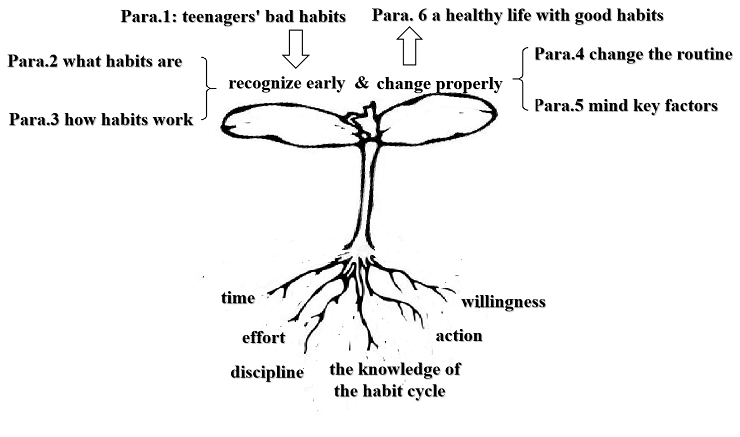
Q2: Are there any alternative ways to better a habit?
Q3: If you are going to conduct a survey about teenagers’ habits in your school, how would you design your questionnaire and what suggestions would you give to people of your age?
【设计意图】 学生反思自身是否具备力量改变坏习惯,是否有其他方法来优化自身习惯。综合文本内容及学生原有知识储备,通过设计问卷的方式,让学生回顾两个课时的内容,包括习惯的特征、运转机制、影响因素、改变路径和方法等待,从而体现学生对习惯更为深入、全面而科学的认识,为树立健康的生活方式起到积极关键的作用。
Assignment
Design a relatively scientific and effective questionnaire to conduct a survey about teenagers’ habits in your school.
【设计意图】 学生能运用习惯的特征、运转机制、影响因素、改变路径和方法,设计一份相对科学的习惯调查问卷,反映中学生生活习惯现状并提出合理的建议,从而帮助更多的学生树立健康生活的态度,践行健康生活的理念。
|
|
 川公网安备51152402000101号 )|网站地图


 发表于 2026-3-10 10:00:07