|
|
Unit 4 History and TraditionsPeriod 2 Reading and Thinking
What’s in a name?导学案

- Read quickly to get the main idea and learn its history of formation; read carefully to get the detailed information.
- Learn to use the reading strategy--- reading maps.
- Guess the new words in a context.
- Use critical thinking and talk about opinions and views about the UK.

- Learn to use the reading strategy--- reading maps.
- Understand the importance of learning a country’s history for learning the country and can express their opinions and views freely by using critical thinking.
- Guess the new words in a context.

Step 1 Leading-in
Look at the maps below and answer the following questions:
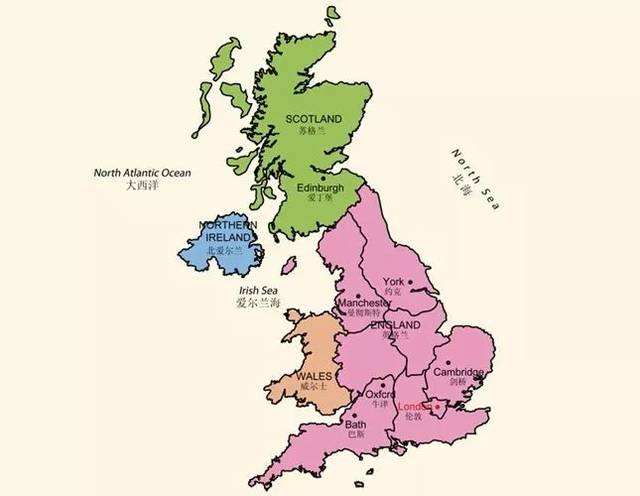
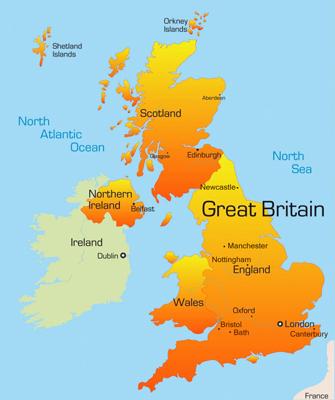
Map 1 Map 2
Read map:When you look at a map, think first about what the map shows and what the symbols mean.Q1: What type of map do they show ?
It’s an administrative zoning map of the UK.
Q2: How many parts can you see that make up the UK in Map 1 ?
It means four regions of the UK
Q3: Can you quickly find the capital of the UK on the map ? Why?
Yes. The red circle stands for London.
Step 2 Before reading--- analyze the title Read the title, what information can you get ?
What’s in a name?
From the title and the map, we can know that the article mainly talks about _______________________________________________________________. So it may be an___________(narration/exposition/argumentation).
Step 3: While reading---Task 1
Read the text and match the main idea.
Part 1(Para1-2) A.The history, traditions and culture of the United Kingdom.
Part 2(Para3) B.The origin of the name of the UK.
Part 3(Para4-5) C.The four countries work together in some areas.
Step 4 While reading---Task 2
Read the text again and fill in the table.
When
| What happened
| What changed
| | Romans arrived
| | | Anglo-Saxons came
| | | Vikings came
| | 11th century
| | | 16th century
| | | 18th century
| | | 19th century
| | | 20th century
| | |
Step 5 While reading---Task 3
Read the text again and answer the following questions.
Q1: How many countries does the UK consist of ?
Q2: What are the four countries of the United Kingdom?
Q3: Which two were the first to be joined together ?
Q4: What are the two chief advantages of studying the history of a country ?
Q5: What’s the author’s attitude towards studying the history ?
Step 6 Post reading---Retell the text
The United Kingdom, Great Britain, Britain, England—many people are confused by (1)_____ these different names mean. In the 16th century, the nearby country of Wales (2) __________(join) to the Kingdom of England. In the 19 th century, the Kingdom of Ireland was added to create the United Kingdom of Great Britain and Ireland. Finally, the southern part of Ireland (3) ______ (break) away from the UK, which resulted in the full name we have today. However, most people just use the (4)_________(shorten) name: the UK. The four countries (5)__________ belong to the United Kingdom work together in some areas.
There were four sets of invaders and the last group were the Normans. They had castles (6)_________(build) all around England and made changes (7)__________ the legal system. Studying the history of the country will make your visit much more (8)_________(enjoy). The capital city London is (9)___ ancient port city that has a history (10)______(date) back to Roman times.
Step 6 Homework
Review what you have learned.
答案:
Step 1 Leading-in
Look at the maps below and answer the following questions:
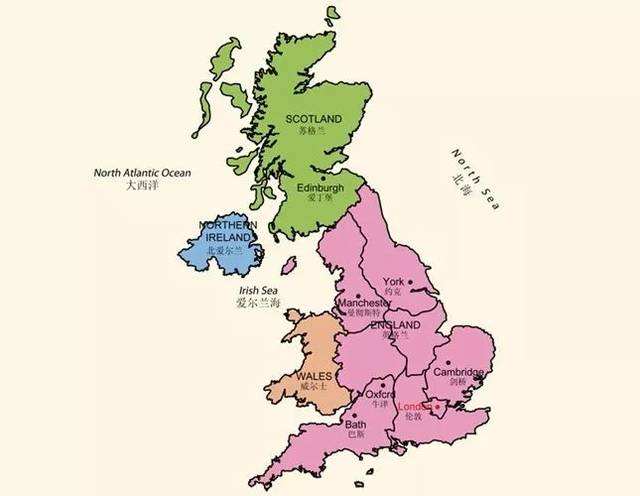
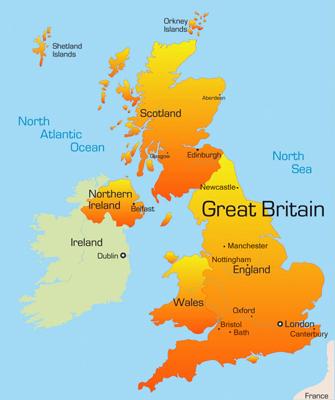
Map 1 Map 2
Read map:When you look at a map, think first about what the map shows and what the symbols mean.Q1: What type of map do they show ?
It’s an administrative zoning map of the UK.
Q2: How many parts can you see that make up the UK in Map 1 ?
It means four regions of the UK
Q3: Can you quickly find the capital of the UK on the map ? Why?
Yes. The red circle stands for London.
Step 2 Before reading--- analyze the title Read the title, what information can you get ?
What’s in a name?
From the title and the map, we can know that the article mainly talks about the name’s changes of the UK, and it may be about the development of history. So it may be an exposition.
Step 3: While reading---Task 1
Read the text and match the main idea.
Part 1(Para1-2) A.The history, traditions and culture of the United Kingdom.
Part 2(Para3) B.The origin of the name of the UK.
Part 3(Para4-5) C.The four countries work together in some areas.
Step 4 While reading---Task 2
Read the text again and fill in the table.
When
| What happened
| What changed
| 1st century
| Romans arrived
| Towns and roads
| 5th century
| Anglo-Saxons came
| Language and way houses were built
| 8th century
| Vikings came
| Vocabulary and names of locations across the UK
| 11th century
| Normans conquered England after the Battle of Hastings
| Castles built , legal system changed, and new words from French introduced
| 16th century
| Wales was joined to Kingdom of England
| | 18th century
| Scotland was joined to England and Wales
| Kingdom of Great Britain formed/created
| 19th century
| Ireland was added
| United Kingdom of Great Britain and Ireland formed
| 20th century
| The southern part of Ireland broke away
| Name changed to United Kingdom of Great Britain and Northern Ireland.
|
Step 5 While reading---Task 3
Read the text again and answer the following questions.
Q1: How many countries does the UK consist of ?
4
Q2: What are the four countries of the United Kingdom?
England, Wales, Scotland and Northern Ireland
Q3: Which two were the first to be joined together ?
England and Wales
Q4: What are the two chief advantages of studying the history of a country ?
The first one is to help you understand more about the country and its traditions.
The second one is to make visiting it more enjoyable.
Q5: What’s the author’s attitude towards studying the history ?
Supportive/positive
Step 6 Post reading---Retell the text
The United Kingdom, Great Britain, Britain, England—many people are confused by (1)_____ these different names mean. In the 16th century, the nearby country of Wales (2) __________(join) to the Kingdom of England. In the 19 th century, the Kingdom of Ireland was added to create the United Kingdom of Great Britain and Ireland. Finally, the southern part of Ireland (3) ______ (break) away from the UK, which resulted in the full name we have today. However, most people just use the (4)_________(shorten) name: the UK. The four countries (5)__________ belong to the United Kingdom work together in some areas.
There were four sets of invaders and the last group were the Normans. They had castles (6)_________(build) all around England and made changes (7)__________ the legal system. Studying the history of the country will make your visit much more (8)_________(enjoy). The capital city London is (9)___ ancient port city that has a history (10)______(date) back to Roman times.
- what 2.was joined 3.broke 4.shortened 5.that 6. built 7.to 8.enjoyable 9.an 10.dating
Step 6 Homework
Review what you have learned.
|
|
 川公网安备51152402000101号 )|网站地图


 发表于 2026-3-7 05:15:59