|
|
Unit 4 History and TraditionsPeriod 1 Listening and Speaking
导学案

1. Understand the content of listening texts in terms of the whole and key details;
2. Guess the meaning of words in listening; discuss with their peers how to talk about historic spots and great person.
3. Learn to use functional sentences of showing one’s excitement, surprise and disappointment.

- Understand the content of listening texts in terms of the whole and key details;
- Guess the meaning of words in listening; discuss with their peers how to talk about historic spots and great person.
- Learn to use functional sentences of showing one’s excitement, surprise and disappointment.

Part A Listening and Speaking--- Share views on historic sites
Step 1 Lead in
Look at some photos of Qufu. What can you say about these places?
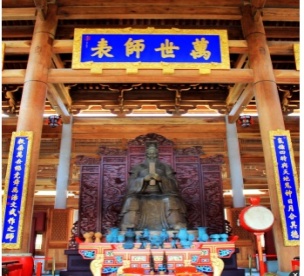
Temple of Confucius Kong Family Mansion Cemetery of Confucius
__________________________________________________________________________________________________________________________________________________________________
Step 2 Before-listening 1. Look at the pictures above and predict what the content is about. _________________________________________________________________________________
- The new words philosopher n.__________ descendant n. __________ philosophy n.__________ noticeable adj.__________
Step 3 While listening---Task 1
Listen to a conversation between a British tourist and a Chinese student in Qufu, and then write down what they say about Confucius.
| Fact/Opinion about Confucius
| William
| - Confucius is one of his favorite philosopher.
- ________________________________________________________
- ________________________________________________________
| Xiao Kong
| - ________________________________________________________
- ________________________________________________________
- ________________________________________________________
|
Step 4 While listening --- Task 2
Listen again and decide whether these statements are true(T), false(F), or not mentioned (NM). Then answer the question.
1. Confucius said that learning without understanding leads to confusion. T F NM
2. Xiao Kong is doing a research project on Confucius philosophy. T F NM
3. As one of Confucius' descendants, Xiao Kong's name is recorded in the family tree.
T F NM
4. Dacheng Hall is the tallest building in Qufu. T F NM
Why do you think William said his hometown was similar to Qufu ?
- There are famous halls in his hometown.
- There are no tall buildings in his hometown.
- Both places have a famous person who was born there.
- His hometown doesn’t allow other buildings to be more noticeable than the historic buildings.
Step 5 Post listening
Understand idiomsAn idiom is an expression which means something different from the meaning of the individual words. Some idioms present an idea or paint a picture that gives a hint as to the meaning. Other idioms can only be understood from the context in which they appear.Write down the English idioms that are used in the conversation. Explain their meanings and think about some Chinese equivalents.
English Idiom
| Meaning
| Chinese equivalent
| Achilles’s heel
| | | Pull one’s leg
| | | Fish out of water
| | |
Step 6 Speaking
Discuss the questions in groups.
- What do you know about Confucius’ idea on education ? Think of two or three examples.
__________________________________________________________________________________________________________________________________________________________________
__________________________________________________________________________________________________________________________________________________________________
- What else do you know about Confucius and his philosophy ?__________________________________________________________________________________________________________________________________________________________________
__________________________________________________________________________________________________________________________________________________________________
- Think about a historic site that you have visited, and give an introduction to its history and importance.
__________________________________________________________________________________________________________________________________________________________________
__________________________________________________________________________________________________________________________________________________________________
Step 7 Pronunciation-- Liaison
- The definition : link the consonant(C ) with the vowel (V)of the next word.
- The rules: 1). C+V: two adjacent words, the former one ends with C, the latter begins with V. Look at the photos.
Add examples of powerful prepositions in English.
2). r/re+V: two adjacent words, the former ends with -r or -re, the latter begins with V.There are many kinds.
3). V+V: two adjacent words, if the former one ends with the pronunciation /ɪ/ or /i:/, the latter word will add the pronunciation /j/; if the former one ends with the pronunciation /ʊ/ or /u:/, the latter word will add the pronunciation /w/. I agree. [aɪj əˈ Go out of the room. [ɡəuw aut əv]
3. Practice
Read this part of the poem “If-” written by British poet Rudyard Kipling. Notice the linking sounds. Then mark the linking sounds after the model.
If you can make one heap of all your winningsAnd risk it on one turn of pitch-and-toss,
And lose, and start again at your beginnings
And never breathe a word about your loss;
If you can force your heart and nerve and sinew
To serve your turn long after they are gone,
And so hold on when there is nothing in you
Except the Will which says to them: “Hold on!”
Part B Listening and Talking---Talk about a visit to a historic tourist destination
Step 1 While listening---Task 1
Backpacker Paul is talking to a receptionist at an international youth hostel in Pingyao, China. Listen to the conversation and tick the places mentioned.
Ming-Qing Street Ancient Government Office Qiao Family Courtyard
Wang Family Courtyard Rishengchang Bank Mount Mian
the city wall Zhengguosi Temple Shuanglin Temple
Step 2 While listening---Task 2
Listen once more. Complete the sentences to describe how the speakers felt.
I had expected something different.
| Paul sounded_________________________
| It was like walking into history.
| Paul sounded_________________________
| It wasn't as big as I had expected.
| Paul sounded_________________________
| Some of the snacks there are amazing.
| Xiao Yan sounded_____________________
| I had no idea there would be so many tourists.
| Paul sounded_________________________
| Wow, I can't believe you didn't see the wall.
| Xiao Yan sounded_____________________
|
Step 3 Post Listening---Talking
Expressing excitement, surprise, and disappointmentI had no idea ... I didn't know .I was eager/surprised to see/learn/hear that …It was so much fun! It was a little disappointing.It wasn't as good/interesting/fun as I'd expected. Imagine one of you has just visited Pingyao. Work in pairs and role-play the conversation below. Then continue the conversation using the following expressions.
Example:
A: Wow, I've just come back from Pingyao. It was amazing!
B: Oh, I loved Pingyao! So did you see the Ming-Qing Street?
A: Of course, but I didn't expect to see so many tourists.
B: Yeah, I know what you mean, but there are some great snacks there. How about the…
__________________________________________________________________________________________________________________________________________________________________
__________________________________________________________________________________________________________________________________________________________________
Step 4 Homework
Take turns telling each other about a historic place that you have been to.
【答案】
Part A Listening and Speaking--- Share views on historic sites
Step 1 Lead in
Look at some photos of Qufu. What can you say about these places?
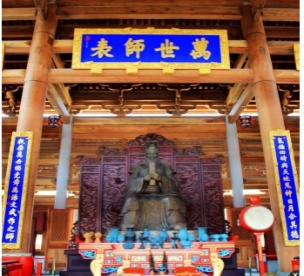
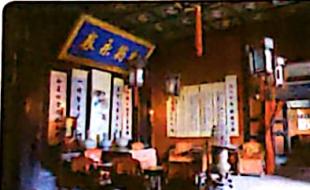
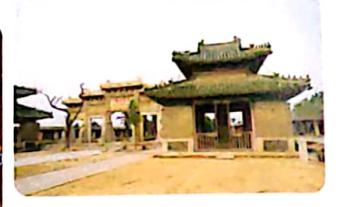
Temple of Confucius Kong Family Mansion Cemetery of Confucius
These places were built to honour the ancient Chinese educator, thinker and philosopher Confucius, w
They are in Qufu, Shandong province , which has become now one of the most famous tourist attractions.
Step 2 Before-listening 1. Look at the pictures above and predict what the content is about. It is about introduction about Confucius and even may be his influence to the Chinese culture and development.
2.The new words philosopher n. 哲学家 descendant n. 后裔,后代,后人;子孙 philosophy n. 哲学 noticeable adj. 显著的,显而易见的
Step 3 While listening---Task 1
Listen to a conversation between a British tourist and a Chinese student in Qufu, and then write down what they say about Confucius.
| Fact/Opinion about Confucius
| William
| - Confucius is one of his favorite philosopher.
- He lived over 2,500 years.
| Xiao Kong
| - Confucius has over 3,000,000 descendants.
- He was a great educator and had many ideas about education.
- He was one of the greatest minds in history.
|
Step 4 While listening --- Task 2
Listen again and decide whether these statements are true(T), false(F), or not mentioned (NM). Then answer the question.
1. Confucius said that learning without understanding leads to confusion. T F NM
2. Xiao Kong is doing a research project on Confucius philosophy. T F NM
3. As one of Confucius' descendants, Xiao Kong's name is recorded in the family tree.
T F NM
4. Dacheng Hall is the tallest building in Qufu. T F NM
Why do you think William said his hometown was similar to Qufu ? D
- There are famous halls in his hometown.
- There are no tall buildings in his hometown.
- Both places have a famous person who was born there.
- His hometown doesn’t allow other buildings to be more noticeable than the historic buildings.
Step 5 Post listening
Understand idiomsAn idiom is an expression which means something different from the meaning of the individual words. Some idioms present an idea or paint a picture that gives a hint as to the meaning. Other idioms can only be understood from the context in which they appear.Write down the English idioms that are used in the conversation. Explain their meanings and think about some Chinese equivalents.
English Idiom
| Meaning
| Chinese equivalent
| Achilles’s heel
| Something that is someone’s weakness
| 弱点要害
| Pull one’s leg
| To joke with someone
| 戏弄
| Fish out of water
| Someone who feels uncomfortable because they are in an unfamiliar place
| 如芒在背
|
Step 6 Speaking
Discuss the questions in groups.
- What do you know about Confucius’ idea on education ? Think of two or three examples.
Education was one of Confucius’ core values. He believed learning about the past would help us know the future. He also thought education helped our confidence which would help bring peace and prosperity. He also thought it was important to use and apply what we have learnt in our education.
- What else do you know about Confucius and his philosophy ? Confucius was a great thinker, educator, and philosopher. His principles had a great influence on Chinese traditions and beliefs. He believed strongly in strong family loyalty and respect for others. He believed in the so-called “golden rule” of philosophy: Do not do others what you do not want others to do to you.
- Think about a historic site that you have visited, and give an introduction to its history and importance.
I visited the Mogao Caves with my family recently. They are famous for their amazing paintings and statues. They were constructed over many dynasties and are an important record of tradition and belief in China during that time.
Step 7 Pronunciation-- Liaison
- The definition : link the consonant(C ) with the vowel (V)of the next word.
- The rules: 1). C+V: two adjacent words, the former one ends with C, the latter begins with V. Look at the photos.
Add examples of powerful prepositions in English.
2). r/re+V: two adjacent words, the former ends with -r or -re, the latter begins with V.There are many kinds.
3). V+V: two adjacent words, if the former one ends with the pronunciation /ɪ/ or /i:/, the latter word will add the pronunciation /j/; if the former one ends with the pronunciation /ʊ/ or /u:/, the latter word will add the pronunciation /w/. I agree. [aɪj əˈ Go out of the room. [ɡəuw aut əv]
3. Practice
Read this part of the poem “If-” written by British poet Rudyard Kipling. Notice the linking sounds. Then mark the linking sounds after the model.
If you can make one heap of all your winningsAnd risk it on one turn of pitch-and-toss,
And lose, and start again at your beginnings
And never breathe a word about your loss;
If you can force your heart and nerve and sinew
To serve your turn long after they are gone,
And so hold on when there is nothing in you
Except the Will which says to them: “Hold on!”
Part B Listening and Talking---Talk about a visit to a historic tourist destination
Step 1 While listening---Task 1
Backpacker Paul is talking to a receptionist at an international youth hostel in Pingyao, China. Listen to the conversation and tick the places mentioned.
Ming-Qing Street Ancient Government Office Qiao Family Courtyard
Wang Family Courtyard Rishengchang Bank Mount Mian
the city wall Zhengguosi Temple Shuanglin Temple
Step 2 While listening---Task 2
Listen once more. Complete the sentences to describe how the speakers felt.
I had expected something different.
| Paul sounded disappointed.
| It was like walking into history.
| Paul sounded amazed.
| It wasn't as big as I had expected.
| Paul sounded disappointed.
| Some of the snacks there are amazing.
| Xiao Yan sounded amazed.
| I had no idea there would be so many tourists.
| Paul sounded surprised.
| Wow, I can't believe you didn't see the wall.
| Xiao Yan sounded surprised.
|
Step 3 Post Listening---Talking
Expressing excitement, surprise, and disappointmentI had no idea ... I didn't know .I was eager/surprised to see/learn/hear that …It was so much fun! It was a little disappointing.It wasn't as good/interesting/fun as I'd expected. Imagine one of you has just visited Pingyao. Work in pairs and role-play the conversation below. Then continue the conversation using the following expressions.
Example:
A: Wow, I've just come back from Pingyao. It was amazing!
B: Oh, I loved Pingyao! So did you see the Ming-Qing Street?
A: Of course, but I didn't expect to see so many tourists.
B: Yeah, I know what you mean, but there are some great snacks there. How about the ticket?
A: It is not very dear about 125yuan. And the transport is very convenient. You can reach there by flight, car or bus.
B: Sounds cool. Anything else to share?
A:Pingyao ancient city is the outstanding example of Chinese Han nationality cities during Ming and Qing Dynasties; remaining all features of such periods, Pingyao ancient city reveals-a picture of unexpected cultural social, economic and religious development in Chinese history. If you travel to this place, it will be unforgettable forever.
B: I will absolutely go there.
Step 4 Homework
Take turns telling each other about a historic place that you have been to.
|
|
 川公网安备51152402000101号 )|网站地图


 发表于 2026-3-7 05:15:34