| |
教学过程
|
教学环节
| 教师活动
| 学生活动
| 设计意图
|
Daily routine
|
Step 1
| Warm up
Teacher greets the whole class as usual.
| | - Activate students and remind them to concentrate.
|
Step 2
| Preview check
Teacher asks students the meaning of words, phrases and knowledge points learnt last lesson.
| Students answer the questions loudly together.
| - Check the teaching situation of last lesson quickly.
- Help students consolidate the knowledge points.
|
Lead-in
|
Step 3
| Saying
Teacher shows the pictures to lead the topic.
- Do you know where the photo was taken?
- Which languages do you think are officially used here?
keys:
- The photo was taken at a United Nations General Assembly meeting.
- English, Chinese, French, Spanish, Arabic, and Russian are officially used here.
| After acknowledging the information and the meaning of the new words, answer the questions.
| - Use pictures to catch students’ attention.
- Expand their horizons and spark their interest.
|
Step 4
| New words
Teacher explains the meaning of the new words, and asks students to translate the meaning of the whole sentence.
There are one billion people learning English now.
billionaire n.
Staying with a native speaker is better for children than simply sitting in a classroom.
natively adv.
Your attitude would be improved when you fix your attention on good things.
positive attitude
negative attitude
Please refer to the dictionary if you don’t know the word.
reference n.
| | - Teach the meaning of new words.
|
Step 5
| Let’s play
Teacher choses students to answer the questions.
- Tom, a _________ Californian, received his doctor’s degree at the University of California.
- If you want to go into the car industry, you’d better have a few _________ dollars.
- From the experience I learnt a lot about how the _________ of the leader can affect the members of a team.
- You can __________ online articles to complete your education.
keys:
- native 2. billion 3. attitude 4. refer to
| | - Familiarize the new words
- Clear the tackle of listening practice.
|
Step 6
| Pair work
Discuss the questions in groups.
Before you listen, match each photo with the correct country name.
keys:
342
615
Discuss which languages are spoken in these countries.
France:
French
Russia:
Russian
Germany:
German
Spain:
Spanish (Castilian); there are several regional languages, such as Catalan and Basque
Canada:
English, French
India:
Hindi, English, there are 22 major languages
| Discuss with their patterner and voice their opinions
| - Familiarize Students with key words.
- Make students use core words and phrases.
- Exercise students’ expression and speaking skills.
|
Listening & Speaking
|
Step 7
| Listening practice
Teacher shows the questions. Then teacher plays the listening material and asks students to answer.
Listen to a speech and tick the two languages with the most native speakers. Circle the official languages of the United Nations (UN).
Keys:
- Arabic; Chinese; English; French; French; Russian; Spanish
Listen to the speech again and answer the questions.
- What is the main topic of this speech?
- How many languages are there in the world?
- How many billion people speak the UN's official languages as their native or second language?
- What is the attitude of the speaker towards foreign language learning?
Keys:
- Learning a foreign language.
- It is very useful to learn one or more foreign languages.
Listen to the speech again.
What do the italicized words refer to in the sentences?
They think it means better job chances in the future.
They are spoken by around 2.8 billion people ...
Keys:
- They: students who choose to study a UN language
- it: studying a UN language
- They: the six official UN languages
| Listen to the materials carefully and do the listening exercises.
| - Familiarize students with key words.
- Exercise students’ speaking skills.
|
Step 8
| Reference
Pronouns (it, they, she, etc.) refer to something or somebody mentioned earlier. Pay attention to the context of words to help you understand what the pronouns refer to.
| Students listen to the tips.
| - Help students learn tips in listening practice.
- Make students master the listening skill better.
- Better finish the testing task.
|
Step 9
| Discussion
Teacher shows the topic and gives students examples to discuss.
Work in pairs or groups. Discuss which other language(s) you want to learn and why.
My father is doing business with Russians. I'd like to learn Russian so 1 can help him in the future.
I like watching Japanese cartoons, so I'd like to learn Japanese.
Perhaps 1 should study French. 1 think it sounds beautiful, and 1 know it's used in many countries.
EXAMPLE:
A: What language do you want to study?
B: I really want to study French. I think that the French language sounds beautiful.
A: Why? Do you want to go to France some day?
B: Yes, I'd love to. Also, French is used by many international organisations around the world. Do you know that FIFA's full name is in French?
A: Oh, I remember that. But I don't know how to pronounce it.
British accent (woman)
American accent (man)
| Use what they have learnt from the interview to help you and discuss in groups.
| - Practice their team spirit.
- Practice their thinking skill and imagination.
- Practice their speaking and listening.
|
Step 10
| Pronunciation
Work in pairs. Read the words to each other and see if you pronounce them differently.
Listen and pay attention to how the speakers pronounce them.
Listen to the paragraph read by two different speakers. Which speaker has a British accent and which has an American accent?
English is a crazy language. There is no egg in eggplant nor ham in hamburger; neither apple nor pine in pineapple. English muffins weren't invented in England or French fries in France. Sweetmeats are candies while sweetbreads, which aren't sweet, are meat. ... We find that quicksand can work slowly, boxing rings are square, and a guinea pig is neither from Guinea nor is it a pig. And why is it that writers write but ... hammers don’t ham? (Richard Lederer)
British accent (woman)
American accent (man)
| Students do the exercises.
| - Improve the students’ pronunciation skill.
|
Step 11
| Pronunciation tips
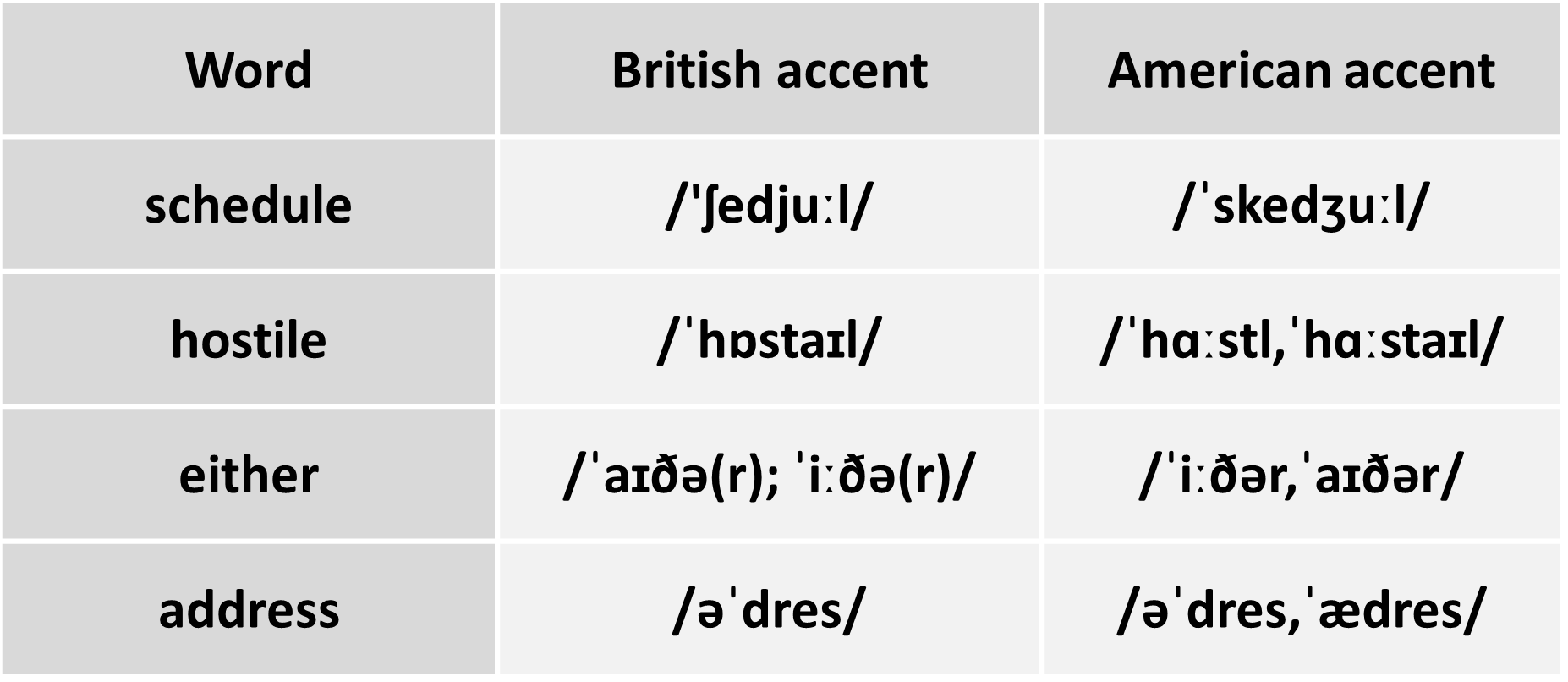
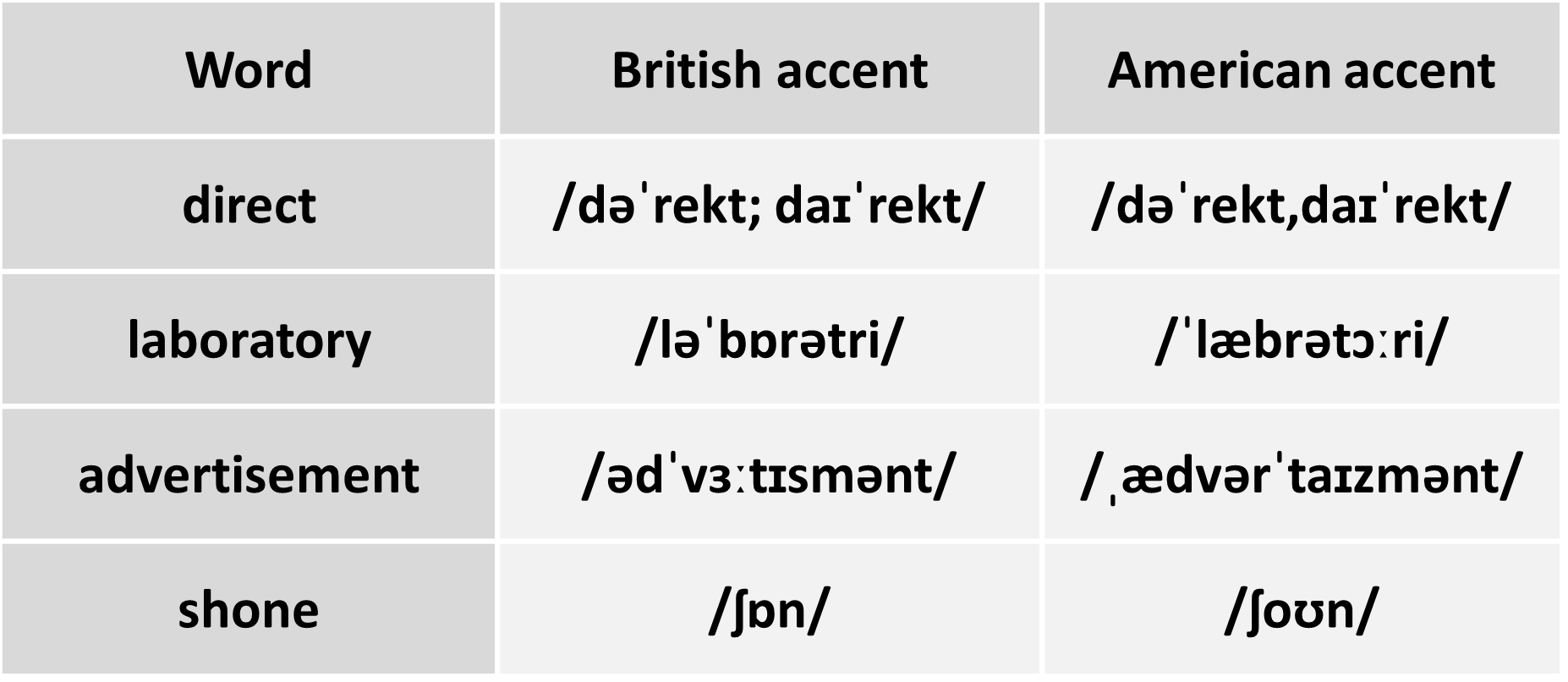
video: British English vs. American English
| Learn the related knowledge point.
| - Help students understand and master related knowledge points.
|
Step 12
| Language points
Teacher explains the language points and makes some exercise.
1. native adj. 出生地的;本地的;土著的n. 本地人
native language
be native to
母语
原产于
The British forced the _________(native) to leave their land by burning their villages.
The kind of horses is not native _________ America – it was introduced by the Spanish.
keys: natives; to
Pandas are native ______ China.
A.with B.to C.for D.in
key: B
A native English speaker ________ limited English speakers finds it hard to talk with African people even though they speak English too.
A. is used to deal with
B. used to deal with
C. is used to dealing with
D. used to dealing with
key: D
2. attitude n. 态度;看法
attitude to/towards
positive attitude
negative attitude
对待…的态度
积极的态度
消极的态度
In my opinion, my best friend changed my attitude _________ life.
It’s generally believed that people act the way they do because of their personalities and _________(attitude).
keys: towards/to; attitudes
What is your attitude __________ this problem?
A. after
B. under
C. beyond
D. towards
key: D
My _________ in teaching is different from yours. A.attitude
B.appear
C. approach
approval
key: C
3. refer vi. 提到;参考;查阅vt. 查询
reference
refer to
refer to…as…
refer…to…
refer to a book/dictionary
in/with reference to
n. 指称关系;参考
指的是;描述;提到;查阅
把…称作…
把…提交给…
查阅书/字典
关于;至于
Your notes are excellent materials _______(refer) to when you are studying for a test.
People who work in offices are usually referred to ________ “white collar workers”.
Jim insisted that the book Mr. Black referred _________ was worth reading.
I have nothing to say in ________ (refer) to that incident.
keys: to refer; as; to; reference
I _______ my success to my family’s support.
A.devote B.contribute
C.refer D.owe
key: D
Devote … to “致力于”contribute … to“贡献” refer …to“参考” owe…to “归功于”
根据句意“他把成功归于家人的支持”答案选D。
If you don’t know the meaning of the word, you can ____the dictionary.
A.refer to B.look into
C.look up D.check
key: A
| Listen to the key knowledge points carefully and take exercise.
| - Help students know about the knowledge points deeper.
- Let students know how to use these words and phrases.
|
Step 13
| Exercise
Teacher asks students to fill the gap together.
Fill in the blanks with the correct forms of the phrases below.
- Money and fame are not __________ happiness. True happiness lies in being satisfied with your life and being grateful for all the things you have received.
- __________ how much money you can earn and how successful you become in the future, you should always remember where you are from and keep your family and friends close to your heart
- Life is always full of __________. Be brave and do not complain when you experience hard times. Just be strong and make the best of things. You will get over tough times sooner than you think.
- Studying is not easy for me at all. However, I fully understand it is something worth putting effort into. I am not __________ good scores in exams, but rather, a chance for a better future.
- Be comfortable with who you are. Be happy and laugh every day. Dance __________ nobody is watching. Sing __________ no one is listening.
keys:
| | |
Summary and Homework
|
Step 14
| Summary
Teacher leads students to have a summary of this lesson.
Language points
billion, native, attitude, reference, refer, refer to
Others:
Explore languages around the world
Reference
British accent and American accent
| Follow the teacher’s thinking flow and read the words and phrases loudly.
| - Consolidate students’ knowledge.
|
Step 15
| Homework
Write an essay about “the language I want to learn”.
| Take notes.
| - Consolidate students’ knowledge and prepare for the following lesson.
|
|
板
书
| Unit 5 Languages Around the World
Period 1 Listening and speaking
Language points
billion, native, attitude, reference, refer, refer to
Others:
Explore languages around the world
Reference
British accent and American accent
|
 川公网安备51152402000101号 )|网站地图


 发表于 2026-3-7 03:52:35