|
|
Unit 12 Life is full of the unexpected.
第一课时 Section A (1a-2d)

【语言知识目标】
1.掌握下列单词和短语:unexpected,backpack,oversleep,ring,by the time,give...a lift
2.理解并掌握下列句子:
By the time I got up, my brother had already gotten in the shower.
But before I got to the bus stop, the bus had already left.
3.掌握语法:过去完成时
【情感与态度】
It’s a good habit to go to bed early in the evening and get up early in the morning.
So you’ll never be in a hurry in the morning.
【策略与意识】
Listen for specific information.
Cooperating.
【教学重点】
1. Train the students to narrate past events with the Past Perfect Tense.
2. Train the students to understand the target language in spoken conversation.
【教学难点】
学会使用过去完成时。

Step 1 Warming up
1. Check homework.
2. New words
(1)Read the new words together.(加强读音训练)
(2)Ask some individuals to read the new words.(发现读音问题,正音)
(课前朗读可使学生快速进入学习状态,养成良好的学习习惯。)
Step 2 Leading in
Discussion
1. Do you like mornings?Why or why not?
2. When do you get up in the morning every day?
3. What do you usually do in the morning before school?
4. Have you ever been late for school? What happened?
(大脑风暴,打开学生思维,初步感知目标语言。)
Step 3 Listening
Before listening
Look at the girl in the pictures and describe what happened.(进一步感知目标语言,为下面的听力做铺垫。)
While listening (输入目标语言,为下面的语言输出做铺垫。)
Listen to Mary talking about her morning. Complete the sentences.
1. By the time I got up, my brother already in the shower.
2. By the time I went outside, the bus already .
3. When I got to school, I realized I my backpack at home.
Check the answers together.
Answers:1. had;gotten 2. had;left 3. had left
After listening
Read the conversation aloud.(增加学生对材料的语感)
Useful language items
by the time=when 引导时间状语从句,用一般过去时态,主句用过去完成时态。如:
By the time I got home, my mother had cooked dinner.我到家时,妈妈已经做好晚饭了。
过去完成时表示在过去某个时间之前已经发生或完成的动作。如:
By the time I got up, my sister had already washed all the clothes.
我起来时,我姐姐已经洗完了所有的衣服。
Get the students to make similar sentences and read them aloud.
Step 4 Pair work
Take turns being Mary. Look at the pictures above and talk about what happened this morning.
A: What happened?
B: I overslept. By the time I got up, my brother had already gotten in the shower.
...
Step 5 Listening
What happened to Mary next?
Listen to Mary continue her story. Number the pictures [1-4] in the correct order.
Answers:3 1 2 4
Fill in the blanks with the correct forms of the verbs in brackets. Then listen again and check your answers.
(1)Read the sentences to the class and then explain them in pairs.
(2)Play the tape recorder.
(3)Tell the students to do the exercises by themselves.[来源:Zxxk.Com]
(4)Play the recording again. Students check their answers by listening to the recording.
Answers:1. got;had left 2. got;had rung 3. walked;had started
Make up an ending for the story and share it with your partner.
The teacher looked at Mary and...
(输出目标语言,对目标语言进行综合训练,体现语言的交际功用)
Step 6 Reading
Kevin had similar experience as Mary today. Read the conversation and answer the questions.
Why was he late?
Because his alarm clock didn’t go off.
When did he wake up?
When he woke up it was already 8:00 a.m.
What did he have to do?
He put on some clothes and rushed out the door.
What happened then?
Before he got to the bus stop, the bus had already left.
How did he come to school?
Carl’s dad gave him a lift in his car.
Read the conversation aloud and role-play the conversation.
Retell Kevin’s story.(多层操练,对教材实行一材多用,多角度感知语言目标。)
Step 7 Summary
Have the students give a summary.
(总结本节课的学习内容,让学生对本节课的学习内容有一个清晰的概念,以便于学生课下复习。)[来源:学+科+网]
Homework
1. Review the useful language items.
2. Preview the new words.

New words and expressions
| Sentences
| unexpected,backpack,oversleep,ring,by the time,give...a lift
| By the time I got up, my brother had already gotten in the shower.
But before I got to the bus stop, the bus had already left.
|

一、用所给单词的适当形式填空
1. We (learn) two thousand words by the end of last year.
2. I (know)him when I was a student.
3. When we (arrive) at the station, they (wait) for more than twenty minutes.
4. One of the men couldn’t move, because he (break) his legs.
5. He said that he (see) the movie before.
Answers:1. had learned 2. had known 3. arrived;had waited 4. had broken 5. had seen
二、翻译下列句子
1.等我吃完饭,新闻已经播完了。
2.当我听到妈妈叫我的时候,我知道我又睡过了。
3.到了学校之后,我发现我把书落在家里了。
4.等我到了,汽车已经走了。
5.他打电话的时候,我已经写完作业了。
Answers:1. By the time I finished dinner, the News had been over.
2. When I heard my mother call me, I knew I had overslept once again.
3. After I got to school, I found I had left my book at home.
4. By the time I arrived, the bus had gone.
5. When he called, I had finished my homework.
第二课时 Section A (3a-4c)

【语言知识目标】
1.掌握下列单词和短语: block,worker,stare,disbelief,burn,alive,airport,till,west,cream,workday,pie,bean,market,in line with,show up,by the end of
2.阅读短文,能按要求找到相应的信息,提高学生们的阅读能力。
3.理解并掌握下列句子:
I was about to go up when I decided to get a coffee first.
We stared in disbelief at the black smoke rising above the burning building.
【情感与态度】
Bad luck may sometimes turns into a good thing.
【教学重点】
1.掌握本部分出现的生词和词组,达到熟练运用的目标。
2.阅读短文,获得相关的信息。通过阅读练习,来提高阅读能力。
【教学难点】
理解并运用所学的词汇及表达方式。

Step 1 Warming up
1. Show the student some pictures and get the students to make sentences with the Past Perfect Tense.
2. Exercises:
Make sentences using “by the time” or “before”.
(1)The coffee became cold. I put cream in the coffee.
(2)The teacher collected the math homework. I got to school.
(3)I completed the work for my boss. The workday ended.
(4)The movie started. I arrived at the cinema.
(5)My mother finished making the apple pie. I got home from my language course.
Answers:(1)The coffee had become cold before I put cream in the coffee.
(2)The teacher had collected the math homework by the time I got to school.
(3)I had completed the work for my boss before the workday ended.
(4)The movie had started by the time I arrived at the cinema.
(5)My mother had finished making the apple pie by the time/ before I got home from my language course.
3. New words
(1)Read the new words together.(加强读音训练)
(2)Ask some individuals to read the new words.(发现读音问题,正音)
(课前朗读可使学生快速进入学习状态,养成良好的学习习惯。)
Step 2 Leading in
Look at the pictures and guess what happened to him?(创设情境,激发学生的学习兴趣)
He overslept. By the time he got to the airport, the plane had already took off. Later he heard that the flight went missing. It was MH370.
What can you learn from him?(大脑风暴,拓展学生思维)
Step 3 Reading
Fast reading
Get the students to scan the passage and answer the question: Which two events does the writer mention?(带着问题初读,感知文本大意。)
Answer: Two planes hit the World Trade Center and the plane, missed by the writer, flew to New Zealand where the earthquake took place the next day.
Care reading
Read the first event and complete the chart.
On September
11,2001
| I arrived at my building
| I was about to go up
| I decided to get a coffee first.
| I was waiting in line
| I heard a loud sound outside
| Before I went outside
| the first plane had already hit my office building.
| Staring in disbelief at the black smoke rising above the burning building .I felt lucky to be alive.
|
(通过问题引导学生理解和学习前半部分文本,利用答案让学生学说目标语言;通过表格做小结,提炼key words。)
Retell the first story using the information in the chart.
Life is full of the unexpected. On...
Read the second story and answer the following questions.
1. When did it happen? Why?
2. Where did he want to go on holiday?
3. What happened then?
4. What did he have to do?
5. What happened in New Zealand the day before?
6. How did he feel?
(通过问题引导学生理解和学习后半部分文本,利用答案让学生学习目标语言)
Post-reading
Retell the second story according the answers to the questions above.
Useful language items
1. be about to do表示即将做某事
如:The plane is about to take off.飞机即将起飞。
注意:不能与时间状语连用,如:I am about to do my homework tomorrow.
但能和when从句连用,构成“be about to do...when”结构:如:
I was about to do my homework when my father came in.
我爸爸进来时我正打算做作业。
2. in line with (与……)成一排
The girl is waiting for bus in line with her friends.
那个女孩正在和朋友们排队等公共汽车。
3. stare指“睁大眼睛、目不转睛地盯着看”,表示一般意义上的盯着看,看得比较仔细,有时候也带有吃惊的意味去看,常与at, into等介词连用。如:
It’s rude to stare at people.
盯着人看是不礼貌的。
We stared at him in amazement.
我们惊奇地注视着他。
4. in disbelief 难以置信,怀疑。如:
I stared at him in complete disbelief.
我直盯盯地看着他,根本不相信。
5. above, on 与 over辨析
(1)above表示位置高于某人或某物。但不一定是正上方,反义词是below。如:
The mountain is more than 4,000 meters above(higher than) sea level.
那座山海拔四千多米。
(2)on表示在一物体上,强调两物相接触。如:
She put her coat on the bed.
她把大衣放在床上。
(3)over表示在某人或某物的正上方,反义词是under。如:
A new bridge will be built over the river.
河上将修一座新桥。
6. alive, living与lively辨析
(1)alive 意为“活着”,侧重说明生与死之间的界限,既可指人,也可指物;可用来作表语、后置定语或宾补。虽有死的可能,但还活着。如:
He wanted to keep the fish alive.
他想让鱼活着。
Is the dog dead or alive?
那条狗是活着还是死了?
(2)living意为“活着”,强调说明“尚在人间,健在”,可用来指人或物,作定语或表语。如:
There are no living things on the moon.
月球上没有有生命的物体。
(3)lively 意为“活泼的,活跃,充满生气的”,可作定语、表语或宾补,既可指人,又可指物。如:
Jenny is a lively girl.
詹妮是个活泼的女孩。
7. till与until辨析
(1)till和until都表示“直到……为止”,主句用延续性动词,主句和从句都用肯定式;表示“直到……才”时,主句用终止性动词,从句用肯定式,主句用否定式。如:
Go straight on until you come to the post office and then turn left.
一直向前走到邮局再向左转。
She won’t go away till you promise to help her.
直到你答应帮助她,她才会走。
(2)区别在于:
until可用于句首,而till通常不用于句首。如:
Until you told me, I had heard nothing of what happened.
直到你告诉我,我才知道出了什么事。
(精讲知识点,使学生掌握并能灵活运用。)
Step 4 Writing
Find words from the passage with opposite meanings to the words below. Then write a sentence with each word.
1. lost:found In May 2001,I found a job in New York at the World Trade Center.
2. west:east I went to my favorite coffee place even though it was two blocks east from my office.
3. below:above We stared in disbelief at the black smoke rising above the burning building.
4. dead: alive I felt lucky to be alive.
5. empty:full The other planes were full so I had to wait till the next day.
Step 5 Game time
Write two true statements and one false statement about your day yesterday. Your classmates then guess the false statement.
1. By the time I left for school in the morning, I had brushed my teeth and washed my face.
2. By the end of the school day, the teacher had started teaching already.
3. By dinner time, I had finished my homework.
Step 6 Summary
Have the students give a summary.
(总结本节课的学习内容,让学生对本节课的学习内容有一个清晰的概念,以便于学生课下复习。)
Homework
Review the useful language items.(及时复习,养成良好的学习习惯。)
Preview the new words in Section B.(能够根据音标读出单词并了解汉语意思,使学生养成自主学习的习惯。)

New words and
expressions
| Sentences
| block,worker,stare,disbelief,burn,
alive,airport,till,west,cream,workday,pie,
bean,market,in line with,show up,by the end of
| I was about to go up when I decided to get a coffee first.
We stared in disbelief at the black smoke
|

一、用所给单词或短语的适当形式填空
rush, forget, send out, go into, show up, find out
1. By the time I arrived at the party, everyone else already .
2. When he put the noodles into a bowl, he realized he to add the green beans.
3. By the time my mother came back from the market, I already out the door to go for my piano lesson.
4. Before she got to the airport, she about the earthquake.
5. When she the e-mail invitation, she remembered she had forgotten to invite Dale.
6. Before she got a chance to say goodbye, he the building.
Answers:1. had;showed up 2. had forgotten 3. had;rushed 4. had found out [来源:学科网]
5. sent out 6. had gone into
二、根据汉语提示完成句子
1. 到上周末为止,我们已经栽了200棵树。
We had planted 200 trees last week.
2.别那样盯着我看。
Don’t me like that.
3.我们将去青岛度假。
We go to Qingdao on vacation.
4.你应该和别人一起排队。
You should with others.
5.他的朋友们满怀疑团地听他讲冒险的经过。
His friends listened to his adventure story .
Answers:1. by the end of 2. stare at 3. are about to 4. wait in line 5. in disbelief
第三课时 Section B (1a-2e)

【语言知识目标】
1.能掌握以下单词和短语:fool,costume,embarrassed,announce,spaghetti
,hoax,discovery,lady,cancel,officer,believable,disappear,embarrassing,sell out,costume party
2.能掌握以下句型:
By the time people realized that the story was a hoax, all of the spaghetti across the country had been sold out.
By the end of the day, more than 10,000 people had phoned the TV station to find out how to get this water.
【情感与态度】
Try to collect the jokes happened on April Fool’s Day and share them with your friends.
【策略与意识】
1. Train the students’ reading skills.
2. Train the students’ writing and speaking skills.
【教学重点】
1.掌握本课时出现的生词及用法。
2.进行听力训练,提高综合听说能力。
3.阅读短文,获得相关信息,提高学生们的综合阅读能力。
【教学难点】
阅读2b部分的短文并完成相关要求。

Step 1 Warming up
1. Check the homework.
2. New words
(1)Read the new words together.(加强读音训练)
(2)Ask some individuals to read the new words.(发现读音问题,正音)
(课前朗读可使学生快速进入学习状态,养成良好的学习习惯。)
Step 2 Revise some of the important words and phrases.
Get the students to read the words aloud together first, then put these words in the correct columns in the chart.(Some words can go in more than one column.)
fool,invite,costume,embarrassed,go off,call,get dressed,empty,show up,realize,change,clock,tired,stay up
Nouns (people,
places, things)
| Verbs (action
words)
| Adjectives
(description words)
| fool,costume,clock
| fool,invite,go
off,call,get
dressed,empty,
show up,
realize,change,
stay up
| embarrassed,empty,tired
|
Step 3 Story time
Tell your partner about something that happened to you recently. Use two or more words in 1a.
Last Friday night, my friend invited me to his birthday party. On Saturday, I got up late and ...
Step 4 Leading in
Show the students some pictures about April Fool’s Day and ask:Do you know about April Fool’s Day?
When is it?Have you ever celebrated it?(创设情境,激发学生的学习兴趣)
Tell the students to discuss in groups and then report what they often do on that day?
Step 5 Listening
Before listening
Get the students to talk about what happened in the pictures.
While listening
Listen for the first time and write each person’s name under the correct picture.
Answers:b:Joe c:Nick d:Dave
Listen again. Who says each of the phrases below?Write D for Dave, N for Nick and J for Joe.
1. D a costume party
2. N my alarm went off
3. J stayed up all night
4. J was tired
5. D was really embarrassed
6. N the other kids showed up
Step 6 Pair work
Tell April Fool’s Day stories in your group. Use the information in 1c and 1d.
A:What happened to Dave on April Fool’s Day?
B: Well, a friend invited him to a costume party ...
Step 7 Reading
Pre-reading
Have you ever played jokes on others, especially on April Fool’s Day? Have you ever been fooled by others?Tell your story to your partner.
While-reading
Fast-reading
Read the passage quickly. Then match each paragraph with the main idea.
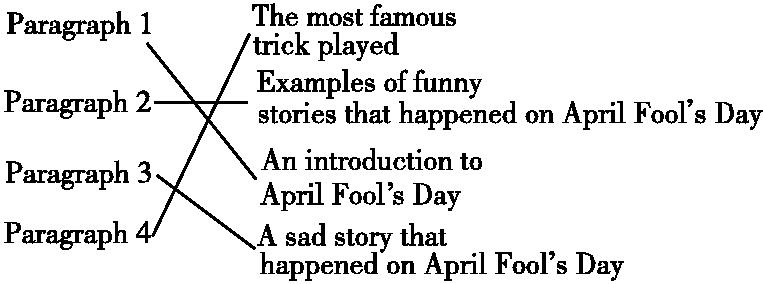
Care-reading
Read the passage again and answer the questions.
1. Why did the supermarkets run out of spaghetti one April Fool’s Day?
2. What did the TV show say the special water could do?
3. Why did the TV star’s joke have a bad ending?
4. When did Orson Welles tell people about aliens from Mars landing on the earth?
5. Why did so many people believe Orson Welles?
Answers:1. Because a reporter announced that the spaghetti farmers in Italy had stopped growing spaghetti.
2. They said this water would help people lose weight and that one customer had already lost a lot of weight in just four months.
3. Because he lost both his girlfriend and his show.
4. In October, 1938.
5. Because he made it sound so real.
Language items
1. take place与happen辨析
(1)take place 表示“发生、举行、举办”,一般指非偶然性事件的“发生”,即这种事件的发生一定有某种原因或事先的安排,如:
Great changes have taken place in our hometown during the past ten years.
在过去的十年里,我们的家乡发生了很大变化。
The Olympic Games of 2012 took place in London.
2012年奥运会在伦敦举行。
(2)happen作“发生、碰巧”讲,一般用于偶然或突发性事件,如:
What happened to you? (一般不说:What did you happen?)
2. as...as one can=as ...as possible尽可能,as..as中间用形容词或副词的原形,如:
Can you say it as loudly as you can / possible?
你能尽可能说得声音大一些吗?
I hope you’ll stay as long as you can/possible.
我希望你尽可能住久一点。
3. sell out 卖完
Sorry, we’re sold out of shirts in your size.
对不起,你这样尺寸的衬衣都卖完了。
This kind of mooncakes have been sold out.
这种月饼已经卖完了。
4. end up
(1)end up doing:结果是(做)……;以(做)……而告终;结果变成……;最后发展为……
(2)end up with以......结束,后面的宾语是其主语的一部分
The meeting ended up with a song.
会议以一首歌结束。
5. so...that...
(1)so+形容词/副词+ that+从句,如:
This story is so interesting that I want to read it again.
这个故事如此有趣以至于我想再读一次。
He spoke so quickly that I couldn’t follow him.
他说得如此快,我不能跟上他。
(2)so+形容词/副词+(a/an)+单数可数名词+that+从句,so+adj./adv.+复数可数名词/不可数名词+that从句,如果句中的名词是单数可数名词,其前就要用不定冠词a或an,如果是复数可数名词或者不可数名词,前面就不用冠词,如:
She is so lovely a girl that everyone loves her.
她是如此可爱的一个女孩,每个人都喜欢她。
Those are so beautiful flowers that the girl wants to pick them.
那些花是如此漂亮以至于那个女孩想要摘下它们。
Step 8 Summary
Have the students give a summary.
(总结本节课的学习内容,让学生对本节课的学习内容有一个清晰的概念,以便于学生课下复习。)
Homework
1. Revise the useful language items.(及时复习,养成良好的学习习惯。)
2. Write a funny story that happened to you.(通过讲故事,设计使用语言情境,从而让学生顺利输出所学习的语言。)

New words and
expressions
| Sentences
| fool,costume,embarrassed,announce,
spaghetti,hoax,discovery,lady,cancel,
officer,believable disappear,embarrassing,sell out,costume party
| By the time people realized that the story was a hoax, all of the spaghetti across the country had been sold out.
By the end of the day, more than 10,000 people had phoned the TV station to find out how to get this water.
|

一、单项选择
1. He dressed quickly he put his shoes on the wrong feet.
A.so;as B. such;that C. so;that D.too;to
2.—We all went to the cinema except you last night. Why didn’t you come?
—Because I that movie twice.
A.have watched B.had watched
C.was watching D.would watch
3. Catherine got married a policeman twenty years ago.
A.with B.for C.to D.at
4. the time I got to the bus stop, the bus had already left.
A. On B.In C.By D.With
5. The Olympic Games of 2016 will in Brazil.
A. take after B.take off
C. take place D.take away
6.—English isn’t as as Chinese.
—Maybe, perhaps it’s just because Chinese is your native language.
A. easy B.easily C.easier D.easiest
Answers:1.C 2.B 3.C 4.C 5.C 6.A
二、用所给单词或短语的适当形式填空
1. After the spaghetti story (appear) in the news, everyone (rush) to the supermarkets.
2. By the time people (find out) the story was not true, all the spaghetti in the supermarkets (disappear).
3. By the time the day (end), more than 10,000 people (call) the TV station to ask about the special water.
4. By the time the show (end), the TV star (lose)his girlfriend.
5. By the time the police officer (tell) the country that the story was a hoax, many people (run away) from their homes. [来源:Z#xx#k.Com]
Answers:1.had appeared;rushed 2.found out;had disappeared 3.ended; had called 4.ended;had lost
5.told;had run away
第四课时 Section B (3a-Self Check)

【语言知识目标】
1.复习A、B 两部分重点单词的用法。
2.复习过去完成时态。
【情感与态度】
Misfortune may be an actual blessing.(塞翁失马焉知非福。)
【教学重点】
1.学会利用所学句型表达“应该做什么”及“不应该做什么”。
2.总结本单元所学到的重点词组及句型。
【教学难点】
Writing

Step 1 Revision
1. Check the homework. Ask some students to read their stories.
2. Review the important words and expressions.(温故知新)
动词 oversleep,ring,burn,fool,announce,cancel,disappear
名词 backpack,block,airport,west,cream,disbelief,pie,bean,market,fool,costume,hoax,discovery,lady,officer,worker
形容词 unexpected, burning,alive,embarrassed,embarrassing,believable
重点短语 by the time,give...a lift,in line with,in disbelief,stare at,show up,by the end of...,sell out
Step 2 Exercise (巩固提高)
Complete the passage with the correct form of the words in the box.
cancel,miss,west,accident,lady,officer,market,unexpected
Last Saturday after my French course, I decided to drive to the to buy a meat pie for dinner. As I was heading , I saw a huge truck in the middle of the road. There had been a(n) and there were many police around. I turned around and decided to go to a nearby mall. However, I the road that led to the mall. Then I saw a restaurant that sold chicken noodles. I went inside and the , who was the owner, served me the most delicious bowl of chicken noodles ever. I had made a(n) discovery! I’m so glad that I
my plan to go to the market.
Answers:market; west; accident; officers; missed; lady; unexpected; canceled
Step 3 Revise the Past Perfect Tense and do the exercises.
Think of ways to finish the answers.
1. A:Why didn’t you hand in your science homework?
B:Before I could start working on it,I realized that I had left my exercise book in school.
2. A:Why didn’t you take a shower this morning?
B:By the time I got up, my brother had already gotten in the shower.
3. A:Why did you have to walk home from school?
B:By the time I left my school,the school bus had already left.
Step 4 Writing(设计语言情景,培养学生综合语言运用能力)
Can you remember a lucky or an unlucky day? What happened? Make some notes about what you remember.(尽可能发散学生思维去描述事件的发生)
What was the date?
| | What happened first?
| | Was this lucky or unlucky? Why?
| | What happened next?
| [来源:Z+xx+k.Com]
| How did the day end?
| | How did you feel about this day?
| |
Write a story about your lucky or unlucky day and tell your story to a partner or the class.
My lucky/unlucky day
I will always remember the date. This was the luckiest/unluckiest day of my life.
When I woke up that morning...
Later that day, ...
I couldn’t believe ...
Then/After that, ...
Finally, ...
I think...
What a lucky/an unlucky day!
(尽可能发散学生的思维,激发学生的写作兴趣,多角度对写作素材进行描述)
Give the students some help if possible.
Ask some students to read their writings.
Step 5 Summary
Have the students give a summary.
(总结本节课的学习内容,让学生对本节课的学习内容有一个清晰的概念,以便于学生课下复习。)
Homework
1. Revise the useful language items in this unit.(及时复习,养成良好的学习习惯。)
2. Preview the new words in Unit 13.(能够根据音标读出单词并了解汉语意思,使学生养成自主学习的习惯。)

Important words and expressions
| Sentence structures
| 动词 oversleep,ring,burn,fool,announce,cancel,disappear
名词 backpack,block,airport,west,cream,
disbelief,pie,bean,market,fool,
costume,hoax,discovery,lady,officer,worker
形容词 unexpected, burning,alive,embarrassed,embarrassing,believable
重点短语 by the time,give ...a lift,in line with,in disbelief,stare at,show up,by the end of...,sell out
| By the time I got up,my brother had already gotten in the shower.
I was about to go up when I decided to get a coffee first.
By the time people realized that the story was a hoax,all of the spaghetti across the country had been sold out.
By the end of the day,more than 1,000 people had phoned the TV station to find out how to get this water.
|

一、根据句意及首字母提示完成单词
1. I have packed the camera in my b already.
2. When he arrived at the a , the plane had already taken off.
3. Because of the bad weather we had to c our plan.
4. Many beautiful fish have d because of serious pollution.
5. Tibet is in the w of China and Shandong is in the east.
Answers:1.backpack 2.airport 3.cancel 4.disappeared 5.west
二、用所给单词的适当形式填空
1. Which of the story is the most (believe)?
2. His father is a (work).He works in a car factory.
3. It is teamwork that makes them (live).
4. Giving money sometimes may make people feel (embarrass).
5. He knows that he had made a real (discover).
Answers:1.believable 2.worker 3.alive 4.embarrassed 5.discovery
|
|
 川公网安备51152402000101号 )|网站地图


 发表于 2026-3-6 05:36:10