|
|
Unit 6 Do you like bananas?
Section B (2a-2c)
Teaching Aims
| Ss can read the article and find out the main idea and details.
star, eat, well, habit, healthy, really, question, want, be, fat, want to do, eating habit, ask sb. about sth
1. Sports star eats well.
2. David asks the volleyball star, Cindy Smith, about her eating habits.
3. Do you like hamburgers for dinner?
4. I don’t want to be fat.
| Teaching Difficulties
| Let Ss read the article and find out the main idea and details.
| Teaching Aids
| multimedia courseware or other realia that the T needs for teaching
|
Teaching Procedures
| Tips
| Step 1 Warm up
| | Review
- T asks Ss to brainstorm different fruit and vegetables.
(T asks students the question: What fruit and vegetables do you know? What other food do you know? Ss can share the fruit and vegetables one by one, and T writes them on the blackboard. If Ss cannot say the words correctly, T must correct them and ask them to say the words again. They can start with fruit first.)
- T asks Ss to look at the pictures on P8, then have a free talk about the following questions.
1. Do you think they are healthy or unhealthy food?
2. Do you usually eat them?
3. What do you think of your eating habits?
(T encourages Ss to share their ideas with the sentences like: I think hamburgers are not healthy. I don’t often eat them. I like … for lunch. T asks two or three Ss to share their ideas.)
| | Step 2Presentation & Practice
| | Pre-reading
2a
- Ask Ss to tick the food which they think are healthy.
After completion of 2a, have Ss work in small groups to conduct a survey. Have each group record the responses of its members. Each group should then summarize and tell the class the responses of its members.
Answers will vary.
Brainstorm
- Ask Ss to write more healthy food and unhealthy food.
Answers will vary.
While-reading
First Reading
- Reading Tip 1: Predicting
- T asks Ss to look at the title and pictures in 2b, try to predict: What's the article about?
(T tells Ss what predict is: to have a guess. Any answer is OK here. Ss can tell the reason why they guess so.)
Second Reading
- Ask Ss to scan the passage and complete the thinking map.
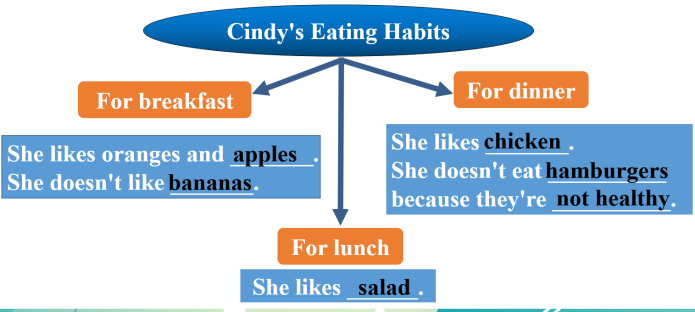
- Ask Ss to judge which sentence is right and which sentence is wrong according to the passage.
- Answers: 1. F 2. F 3. T 4. T 5. T
Third Reading
T asks Ss to retell the passage.
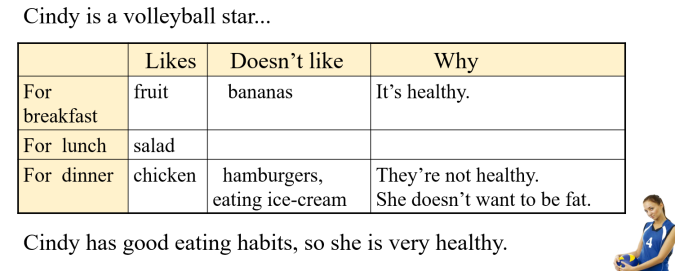
(T can use the table above and give some clues to help Ss retell. T can say the first words of the sentences or use transitional words or questions to remind them of the next sentence if students forget. There will be some grammatical mistakes when they are retelling, so teachers must use some transitional words to connect the sentences together, or to correct their pronunciations.)
2b
- Ask Ss to read the magazine article and circle the food words.
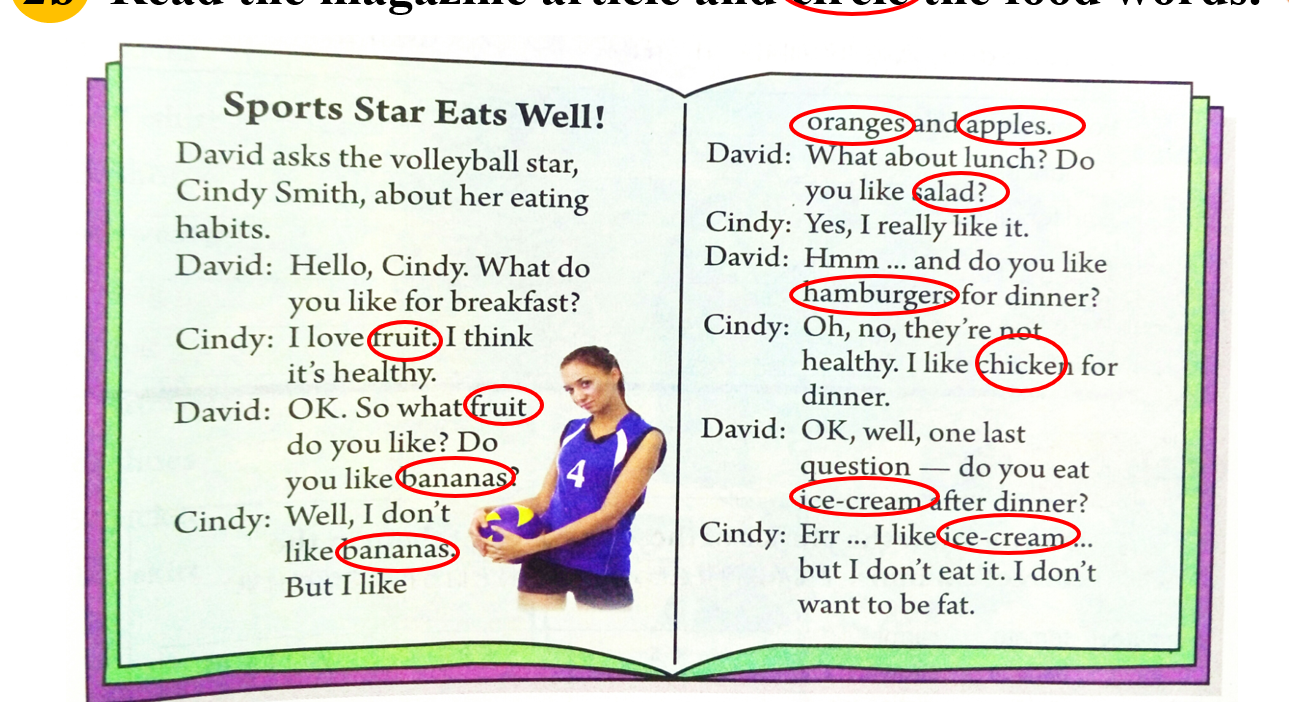
- T ask Ss to write down the food that Cindy likes for meals and David likes for meals.
T: Just now you have circled all the words about food. What does Cindy like for breakfast, lunch and dinner? What does David like for breakfast, lunch and dinner? Now write B for breakfast, L for lunch and D for dinner after the words.
- Let each S take out a piece of paper. Show Ss PPT P18 and ask them to write down the Chinese translation for each phrase.
- Ask Ss to write down five sentences about Cindy’s eating habits.
- While Ss are completing 2c, walk around the room and look at the sentence of different Ss. Choose sentences in which there are common errors, and write these sentences on the board. Then have Ss work in pairs to find the errors and suggest corrections. Elicit from Ss how to correct the sentences, and make the corrections on the board.
- Optional choice: Divide Ss into groups of four. Ask them to discuss what they like to eat for each meal. T can encourage Ss to say more about their preferences, e.g. I like ... but I don’t like ..., I always / never have ... for ... (T can write these sentences on the board if necessary).
| | Step 3Language points learning
| | 在Sports star eats well.这句话中,well作副词,修饰动词eat。
healthy的常用短语有:stay / keep healthy 保持健康 healthy food 健康食品
【拓展延伸】
health n. 健康unhealthy adj. 不健康的healthily adv. 健康地
want的用法:
(1)want to do sth. 想要做某事
(2)want sth. 想要某物
(3)want sb. to do sth. 想要某人做某事
ask 的用法:
ask sb. about sth. 就某事询问某人
ask for 寻求;要求ask to do sth. 要求做某事ask sb. to do sth. 要求某人做某事
| | Step 4 Exercises& Homework
| | Exercises
- Ask Ss to do the exercises on PPT P25-P27.
- T asks Ss to make a summary about what they learned today.
Homework
- Read and recite the new words and phrases.
- Do the exercises in students’ book.
| | Teaching Reflection
| I used various forms of reading strategies, such as skim, scan, retell, etc. to help students quickly understand the passage. I paid a lot of attention to the usage of the language points and let students make enough sentences to master the language points, so Ss can master the language points and understand the passage clearly.
|
|
|
 川公网安备51152402000101号 )|网站地图


 发表于 2026-3-2 06:04:35