|
|
Unit 5 Do you have a soccer ball?
Section A (Grammar Focus-3c)
Teaching Aims
| Ss can learn touse have to talk about ownership.
great; play; sound
1. —Do you have a baseball? —Yes, I do./No, I don’t.
2. —Does she have a tennis ball? —Yes, she does./No, she doesn’t.
3.—Well, let’s play basketball. —That sounds good.
| Teaching Difficulties
| Ss are able touse have to talk about ownership.
| Teaching Aids
| multimedia courseware or other realia that the T needs for teaching
|
Teaching Procedures
| Tips
| Step 1 Warm-up
| | - Show Ss teaching goals in this class.
T: Morning everyone. Today we are going to learn to use have to talk about ownership.
- T ask Ss to see the pictures and answer question: What does Mr. Clark have in his hat?
(T asks students to use the sentence pattern: He has a/an ... to answer the question. If Ss say he have… T must correct their grammar mistakes.)
- Show Ss pictures on P6-P9 and ask them to answer questions on PPT.
(If Ss can’t answer the questions correctly, T must give them guidance, and ask them to say the sentence again. T can also make a summary about the sentence patterns:1. --Do you have a soccer ball? --Yes, I do. 2. --Do they have a tennis ball? --Yes, they do. 3. --Does your brother have a basketball? --Yes, he does. At the same time T must give students positive comments to encourage.)
| | Step 2Grammar learning
| 动词第三人称单数是初中的难点,老师应该通过多造句和对话,使学生理解更牢固。
| - The T can ask Ss to read the sentences in the chart and pay attention to their pronunciation and intonation. Then guide them to distinguish when to use have/do and has/does. Draw their attention to the usage of the target language.
- At last the T can summarize the usage of the target grammar structure from several aspects.
| | Step 3Presentation & Practice
| | Ask Ss to read these words in the box in 3a and translate them. Then
Ss do the task in 3a and the T can invite some Ss to share their answers.
Answers:
do: I they you we
does:he she it Eric
- Step 1:Ask students to find out the subject of the sentence first, and then fill in do or
Step 2:Teachers can encourage students to raise their hands and ask questions they don't understand, and let other students help solve these problems. In this part, Ss can consolidate let's...sentence pattern again.
Step 3:Ask the whole class to read the three groups of dialogues aloud, and the teacher will correct the pronunciation mistakes.
Step 4:Let students practice dialogue with their partners in roles.
Step 5:Ask several groups of students to role-play the dialogue as open pairs.
Answers:
1. Do do 2. Does doesn’t does does 3.Do do
This activity is a game that challenges students' memory. Teachers should try to make the activity interesting for Ss and let them review and consolidate grammar knowledge in the game.
Step 1:The teacher first asks the students to say the English names of various objects in the room as much as possible. For example:
T:look at the picture This is Bob's room. What can you see in his room?
S1:A volleyball.
S2:A soccer ball.
S3:...
Step 2: Let Ss work in pairs. Let student B look at the picture for one minute, then close the book and answer student A's question. According to the content of the picture, the two Ss use the verb have to ask and answer, and practice the general question sentence guided by the auxiliary verb does:
A:Does Bob have a soccer ball?
B:Yes,he does./ No he doesn't.
After student A asks about several items, they exchange roles and practice again. Depending on the basis of students, students can expand the scope of questions to other items in the room.
- To further challenge Ss when doing task 2c, ask them to ask and answer questions about the location of things, too. Remind Ss as necessary of the prepositional phrases using "on", "in" and "under." Tell Ss they can ask and answer questions about other belongings, not just sports equipment. Direct Ss' attention to an example on the board:
A: Does he have a pen?
B: Yes, he does.
A: Where is it?
B: It's on the table.
| | Step 4Language Points
| | 1.great adj. 美妙的;伟大的
great独立成句,常用于口语中,表示说话人的喜悦之情,通常意为“太好了”。
2.play v.参加(比赛或运动); 玩耍
1) play在此处是及物动词,后接表示球类运动的名词时,play 与球类运动名词之间不加冠词。
2) play作动词还可意为 “玩耍”,play with sb./sth.表示“和某人一起玩/玩……”。
3) play作动词,还可意为“演奏;弹奏” ,后接表示乐器的名词时,乐器名词前要加定冠词the。
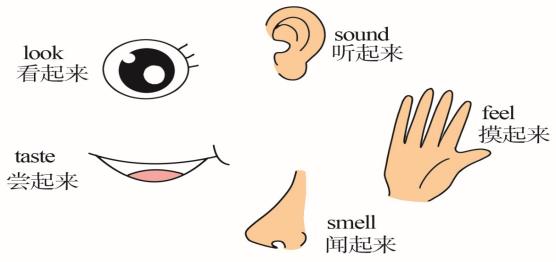
3. sound v.听起来好像
sound在此处作连系动词, 也是感观动词, 后常接形容词作表语。
常见的感官动词:
| | Step 5Exercises & Homework
| | Exercises
Ask Ss to do the exercises on P30-P32.
Ask Ss to make a summary about language points they learned today.
Homework
1. Preview the new words and phrases in Section B(1a-1d).
2. Do the exercises in students’ book.
| | Teaching Reflection
| I didn’t do well in explaining the grammar part. Well, the third singular form of verbs was a little complicated, so the students didn't fully understand it, especially the B-level Ss. So I need to help them understand it through practice in the next class.
|
|
|
 川公网安备51152402000101号 )|网站地图


 发表于 2026-3-2 06:03:11