|
|
Unit 3 Is this your pencil
Section A (Grammar Focus-3c)
Teaching Aims
| Ss can usethe possessive pronouns to identify ownership.
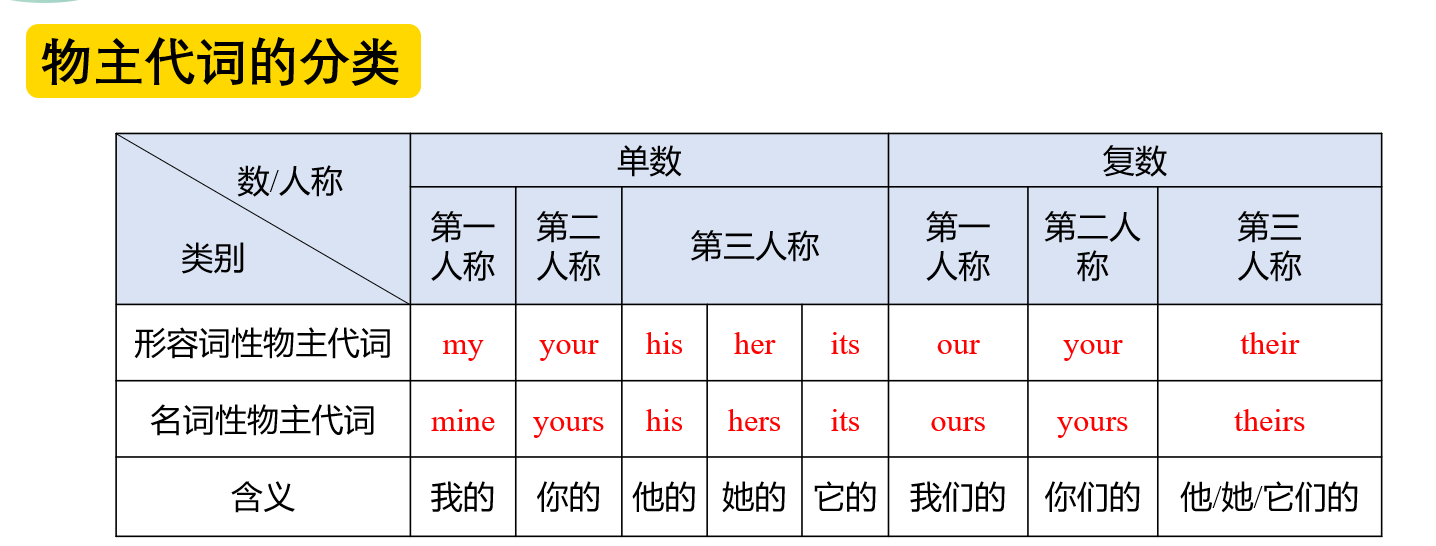
mine; hers; his; yours.
1. —Is this your pencil? —Yes, it is. It’s mine./No, it isn’t. It’s hers.
2. —Is that your schoolbag? —Yes, it is./No, it isn’t. It’s his.
3. —Are these your books? —Yes, they are./No, they aren’t. They’re hers.
4. —Are those her keys? —Yes, they are./No, they aren’t. They’re mine.
| Teaching Difficulties
| Ss are able to introduce things with proper personal pronouns and possessive pronouns.
| Teaching Aids
| multimedia courseware or other realia that the T needs for teaching
|
Teaching Procedures
| Tips
| Step 1 Warm-up
| 开头的chant不仅复习了所学知识,而且极大吸引了学生对课堂的兴趣。
通过选数字看图说词,复习上节课所学单词或短语。
游戏环节大大提高了课堂趣味性。
| - Show Ss teaching goals in this class.
T: Morning everyone. Today we are going to learn to usethe possessive pronouns to identify ownership.
- T ask Ss to chant together.
(T should chant for Ss as a sample. We can ask Ss to clap the hands or pat the
desk to make a rhythm.)
- Show Ss pictures on P6-P9 and ask them to answer questions on PPT.
(If Ss can’t answer the questions correctly, T must give them guidance and ask
them to say the sentence again. T can also make a summary about the sentence
patterns. At the same time T must give students positive comments to encourage
them.)
- T ask Ss to play a number game about words and phrases.
T: Let’s play a game together. You can choose one number you like, and translate. Now let’s see who is the fastest.
(T ask Ss to use a complete sentence to answer the question: What’s this? It’s a …)
- T ask Ss to play a number game about sentences.
T: There is another game for you. You can choose one number you like, and translate the sentence. Now let’s see who can say it well.
(T should correct Ss if they have wrong answers, and ask the student to say the correct sentence again.)
| | Step 2Grammar learning
| 本部分的语法是重难点,老师应该多引导学生自主探索或小组合作探索这些语法,从而记得更牢固。
通过表格让学生更好的体察形物代和名物代的区别。
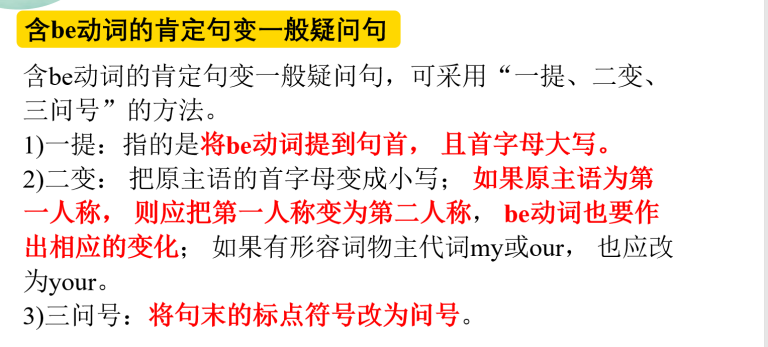
| - Ask Ss to read the contents on grammar focus part and make a summary about how to use the target language.
(T can show the questions on the blackboard like: What is the form of a question sentence? What be verb can we use in a question sentence? What do these the possessive pronouns refer to? Ask them to talk about the questions in groups and have a try to make some conclusion.)
含be的一般疑问句
物主代词的比较和分类
| | Step 3Presentation & Practice
| | - Ask Ss to observe the two pictures in 3a and tell the differences between them. Then have Ss fill in the blanks and T can invite some Ss to share their answers.If possible, the T can ask why they choose the answer.If Ss have problems, the T should explain the related knowledge clearly.
- Answers: Questions: this, these, that, those
- Answers: isn’t, they, is, aren’t
- Ask Ss to fill in the blanks in 3b. Then Ss can check answers with partners. At last the T can choose some Ss to role-play the dialogue to make sure they get the correct answers.
Answers: it is hers it isn’t hers they are his they aren’t they are
T can collect some things from Ss before class and put these things into a box. Then each S take one thing in class and try to find out the owner. T show sentence patterns on the blackboard to help Ss ask and answer fluently. T should walk around to give guidance in case some students can’t understand the instruction.
| 这个全班互动很有效的调动了学生积极性并帮助他们练习句型。
| Step 4 Exercises & Homework
|
| Ask Ss to do the exercises on PPT P27-P29.
Guide Ss to make a summary about language points they learned today.
Homework
1. Preview the new words and phrases in Section B(1a-1e).
2. Do the exercises in students’ book.
| | Teaching Reflection
| This lesson extends from the first lesson to the use of plural forms of nouns to practice the use of general questions and nominal possessive pronouns. Students can practice through a large number of listening, speaking, reading and writing activities, and can also consolidate through grammar explanation and deepening practice. The teaching activities arranged in this class can enable students to practice and master key knowledge.
|
|
|
 川公网安备51152402000101号 )|网站地图


 发表于 2026-3-2 06:01:01