|
|
Unit 3 Where did you go ? partA
| 教学目标
| 知识与能力目标
| ●能够听、说、读、写句型:Where did you go ? Did you… ? Yes, we did . No, we didn’t. How did you go there ?
●能够在情景中运用句型:Where did you go ? Did you … ? Yes, we did. No, we didn’t. How did you go there ? 询问并回答别人在过去的时间里去了哪里,乘坐什么交通工具。
●能够听、说、读、写单词: rode a horse, rode a bike, went camping, went fishing, hurt my foot, took pictures, went swimming, ate fresh food, bought gifts.能够正确使用上述词组谈论和描述人物在过去做的事情
●了解新疆的风土人情。
| 课时安排
| 3课时
|
第一课时
教学内容
| A. Let’s try Let’s talk
| 课 型
| 对话教学
| 教学目标
| - 学生能够听、说:What happened ? Are you all right ? I’m OK now. Where did you go ? It looks like a mule ! Did you go to Turpan ? Yes, we did.
| 教学重点难点
| ●在实际情景中灵活运用句型:Where did you go ? I went to…? 来与他人进行交流。
| 教学准备
| 课件、图片
| 教学步骤:
Step 1. Warm-up
1.利用图片和学生一起唱歌谣,要求一边唱一边做动作。如:
What can you do ? I can sing.
What can you do ? I can dance.
What can you do ? I can climb a mountain.
What can you do ? I can take a pictures.
 What can you do ? I can speak Chinese.
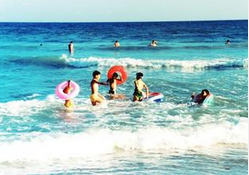
2.用多媒体课件展示自己外出旅游的照片,并做相关介绍。如:
Last summer holiday, I went to Hainan. It was so beautiful. I went swimming in the sea. And picked some seashells on the beach.
Step 2. Presentation
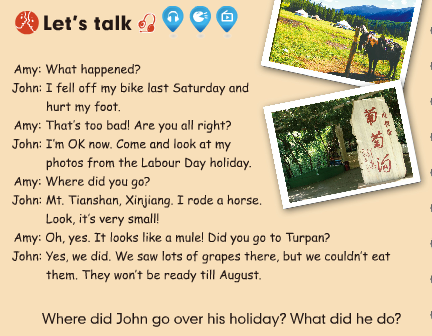 Let’s talk
(从呈现完整对话到处理局部语言)
(1)通过提问要求学生猜测:Did you
go to John’s home ? What happened to
John? What did they talk about later?
请学生带着问题观看动画或阅读文本,了
解John脚受伤的原因:He fell of his
bike,利用图片帮助学生理解并教授fell.
同时,通过观看动画或阅读文本获得
对话的主旨:They talked about John’s Labour Day holiday.
(2)结合日历Labour Day holiday概念。提问:Look at the calendar. What date is it ? It’s May 1st . On May 1st ,we usually have three days off. We call it Labour Day holiday.
(3)继续提问学生:Where did John go on his Labour Day holiday ? What did he do there ? 要求学生带着问题观看动画或阅读文本获取信息,并用思维导图板书对话关键信息。
John’s Labour Day holiday
Where did he go ? What did he do ? ?
(4).结合思维导图,描述John’s Labour Day holiday,然后让学生提问:What else do you want to know about John’s Labour Day holiday ? 鼓励学生对John的假期提出问题:Who did John go with ? Was he happy ? What did people wear there ? Could they dance well ? 等等。结合学生的问题,利用图片或视频介绍新疆风土人情,并让学生对此进行适当的对话拓展。
(5).呈现Let’s talk的插图,提问学生:Look at John’s pictures. Where is it ? Mr. Tianshan or Turpan ? Can you guess ? 让学生把插图与思维导图中的地点进行匹配,并在此过程中向学生介绍Mt. Tianshan和Turpan的风土人情,教读mule, Turpan, could 和till.
(6).根据文本内容引出句型并帮助学生理解句型。
问:Let’s have a look at John’s Labour Day holiday again. Where did he go over his holiday ? What did he do ? 引导学生回答:He went to … He…
根据思维导图中的句子解释Where did he go…? What did he do ?的用法。
2.巩固与拓展
(1)两人小组活动。学生两人一组,每人长纸条上写两个过去时的句子,然后把句子在单词间的空隙处剪开。学生交换剪下来的单词,看谁能最先把同
(2)组织学生分角色朗读对话,请学生给对话配音。
(3)让学生复述John的五一假期。
(4)四人小组活动。
Step 3. Practice
Let’s try
1.放录音,学生完成第一、二题。
2.追问学生Why was John at home ?引导学生进行猜测。再次放录音,学生根据录音完成第三题,验证之前的预测。
Step 4. Consolidation and extension
1.学生背诵本课时的四会句子。
2.做同步精练的相关练习。
| Unit 3 Where did you go ?
What happened ?
Are you all right ? I’m OK now.
Where did you go ?
It looks like a mule.
Did you go to Turpan ? Yes, we did.
| 教学反思
| 本课以说唱歌谣的形式来导入新课,一方面激发了学生的学习兴趣,另一方面让学生了解本课所要学习的内容,为后面新的知识的学习做了铺垫。
新课教学阶段,教师以师生的会话的形式展开教学,学生在轻松的谈话氛围中学习知识,同时还进行了相关知识的拓展,有利于学生融入到真实的语言环境中,将所学的重点单词和句型运用到以后的对话交流中去。
在巩固新知阶段,教师以教学内容为中心,充分考虑到教学实际,特地设计了“采访”游戏这一环节,使学生在轻松、愉快的氛围中巩固新知识。
|
第二课时
教学内容
| A. Let’s learn , Listen,answer and write
| 课 型
| 单词教学
| 教学目标
| - 能听、说、读、写以下动词短语: rode a horse, rode a bike, went camping, hurt my foot, went fishing.
- 能运用一般过去时来询问别人在假日里去了哪里、干了什么并作答。
| 教学重点
| 运用五个动词短语来进行句型替换练习
| 教学难点
| 掌握三个动词短语过去式的读音和拼写
| 教学准备
| 图片、照片与课件
| 教学过程 :
Step 1 : Warm-up
1.师生进行连锁问答练习,如:
T: I went to Xinjiang on my holiday .
Where did you go on your holiday?
S1: I went to.... Where did you go on your holiday?
S2: I went to.... Where did you go on your holiday?
S3: I went to.... Where did you go on your holiday?
……
Step 2 : Presentation
Let’s learn
利用教材中的情景展开词汇教学
1.利用图片整体呈现本部分单词并教授。教师利用挂图呈现A.Let’s learn板块的插图,提问:
T: Look, this is John’s blog. When did he send pictures and write
on the bIt was May 1st , the Labour Day holiday. What did
he do on Labour Day holiday ?
然后要求学生看图,说出John 五一假期所做的事情:
S: He rode a horse. He went camping . He went fishing.
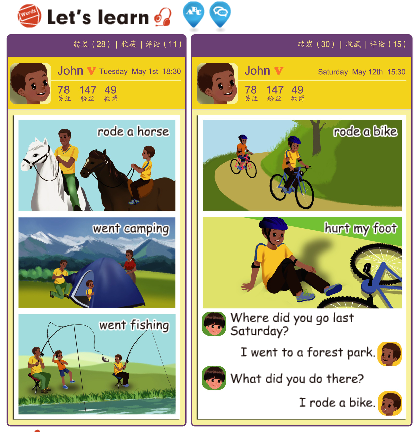 教师根据学生的回答继续追问:
T: Where did he ride a horse ? What was the weather like there on Labour Day holiday ?
Who did he ride a horse with ? How did he feel ?
引导学生根据自己对新疆的了解,结合图片,发挥想象,针对John在新疆旅游的细节进行对话。教师教授rode a horse, went camping, went fishing的时候,注意rode 和a之间的连续。
2.教师提问学生
T: Jd a good time in Xinjiang on Labour Day holiday. Last weekend, he also had two
Days off. Where did he go last Saturday ? What did he do there ?引导学生猜测John上周末去的地方和做的事情,然后听课文录音,获取信息后,验证之前的猜测,再教授rode a bike.
3.围绕课文插图John五月十二日微博的内容,教师继续与学生一起讨论John上周末的活动。教师提问:
T: What else did he do last Saturday? Who rode a bike with him ? Was it fun to ride a bike in the forest park ? What happened to him later? If you were John, what would you do ? 引导学生谈论并回答,教师教授hurt my foot.
4.教师播放Let’s learn中的录音,学生跟读,然后让学生两人一组进行对话。
Step 3 : Practice
1.教授自编Let’s chant
What did you do on your holiday ?
I rode a horse. I rode a horse.
What did you do on your holiday ?
I rode a bike. I rode a bike.
What did you do on your holiday ?
I went camping. I went camping.
What did you do on your holiday ?
I hurt my foot. I hurt my foot.
What did you do on your holiday ?
 I went fishing. I went fishing.
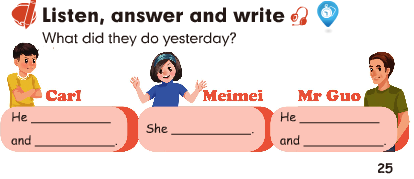
2.教Listen, answer and write
教师播放此部分录音,学生完成相关练习,
然后以教师问学生答的形式核对答案。
Step 4 : Consolidation and extension
1.学生背诵并抄写本课时的四会动词短语。
2.做同步精练相关的练习。
| 板书设计:
Unit 3 Where did you go ?
Zhang: Where did you go last Saturday ?
John: I went to a forest park.
Zhang: What did you do there ?
John: I rode a bike.
rode a horse.
went camping.
went fishing.
hurt my foot.
| 教学反思
| 本节课继续式的变化形式,涉及语法知识。教师没有过多地去讲解语法知识,而是通过对比的形式来帮助学生掌握动词的过去式,让学生从板书上、朗读中直接接触新知识,使学生以最简捷的方式来完成学习任务。教师以图片、情景对话、动作模仿等方式进行短语教学,使学生快速高效地完成课堂学习任务。
|
第三课时
教学内容
| B. Let’s try Let’s talk
| 课 型
| 对话教学
| 教学目标
| - 能听、说、读、写以下句子:How did you go there ? We went there by plane. Sounds great !
| 教学重点
| 掌握重点句型
| 教学难点
| 灵活运用对话中的句型进行口语交流。
| 教学准备
| 图片、课件。
| 教学过程 :
Step 1: Warm-up
1.教师请几名学生描述自己上周做些什么,如:
I was busy last week. On Monday I went to a restaurant. On Tuesday I went to a park. I rode a bike. On Wednesday I played ping-pong. On Thursday I went camping. ...
2.日常进行日常会话交流,如:
T: What did you do on your holiday ?
S1: I rode a horse.
T: What did you do on your holiday ?
S2: I rode a bike.
T: What did you do on your holiday ?
S3: I went fishing.
…..
3. 师生齐声说唱chant, 如:
How do you go to school ?
By bus, by bus.
How do you go to the park?
By bike, by bike.
How do you go to the science museum ?
By taxi, by taxi.
……
Step 2: Presentation
Let’s try
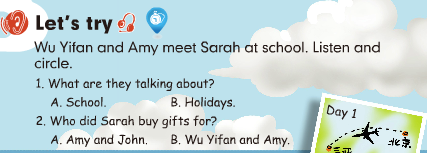 1.听前预测。教师出示人物图片,介绍听力活动背景: Who are they ? Wu Yifan and Amy are at school. They meet Sarah. 老师引导学生阅读第一个问题,然后提问:What are they talking about ? Can you guess ? 让学生进行听前猜测。
2.教师放第一遍录音,要求学生回答第一个问题。
3.教师问:What did Sarah do there ? 让学生根据自己对杭州的了解进行猜测。然后老师放第二遍录音,学生回答问题后,教师还可提问:What was the West Lake like ? What else could we do in the West Lake ? 引导学生谈论杭州西湖。
4.教师提问:Sarah bought some gifts. Who did she buy gifts for ? 教师放第三次录音,并核对第二题答案。
Let’s talk
(从呈现完整对话到处理局部语言)
提问:Sarah went to Hangzhou last winter holiday.
What about Amy ? Where did she go ? How did she
Go there ? What did she do ? 要求学生带着问题
观看动画或阅读文本后回答问题。板书如下:
When did she go ?
Where did she go ? Amy’s Trip How did she go there?
What did she do ? ………
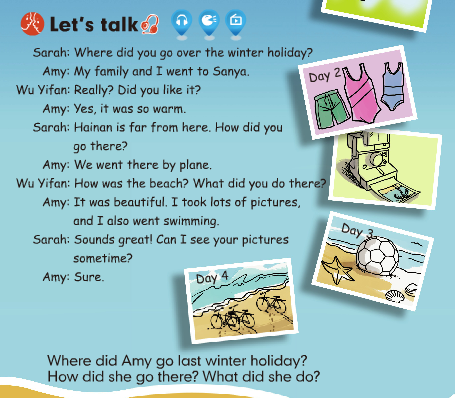 2.教师与学生谈论Amy的三亚之行。老师呈现A.Let’s talk 板块的插图,提出问题: What did Amy do on the first / second / …day ? How did she feel ? What was the weather like there ? What did she eat there ? Did she … ? 引导学生结合图片,发挥想象,对Amy在三亚旅游的细节进行对话,并教读单词beach.
3.教师引导学生根据Amy’s trip 的思维导图,发挥想象,描述Amy’s trip. 此活动可先在四人小组内进行,然后全班分享。
4.教师用PPT呈现或板书Amy旅游信息的句子,要求学生根据提供的信息推断出合适的疑问句。
Amy’s Holiday Trip
___________________________?
I went to Sanya.
___________________________?
I went there over the winter holiday.
___________________________?
I went there by plane.
___________________________?
I took lots of pictures.
___________________________?
……
Step 3 : Practice
1.学生两人互相询问对方曾经去过的地方和所乘坐的交通工具,然后制成表格。可请几名学生上台表演报调查结果,如:
S1: I went to Zhejiang last year.
S2: How did you go there ?
S1: I went there by train.
…….
Where
| Zhejiang
| | | | How
| By train
| | | |
2.学生之间讨论自己是怎样度过寒假。
Step 4 : Consolidation and extension
1.学生朗读本课时的四会句子。
2.做同步精练的相关练习。
| 板书设计:
Unit 3 Where did you go ?
A:How did you go there ?
B: We went there by plane.
A: Sounds great!
| 教学反思
| 本课主要培养学生的听力能力和口语表达能力。在教学中,老师先以听力训练为基础,让学生在听清楚正确发音的基础上进行模仿发音,再让学生通过分角色对话来练习口语,互补不足。这样进行教学,一方面给他们提供了自由表达的空间,另一方面极大地提高了学生的口语表达能力。教学过程中,教师以学生说为主,老师引导为辅,能锻炼学生开口说英语的能力,学生说也是以自身实际为主,能让英语深入到学生的实际生活中。
|
|
|
 川公网安备51152402000101号 )|网站地图


 发表于 2026-3-1 04:56:52