|
|
L 新人教版(2019)英语选择性必修一
Unit4 Body Language
Period 3 Discover useful structures教学设计
课题
| Period 3
Discover useful structures
| 单元
| Unit4
| 学科
| English
| 年级
| Senior
Grade 2
| 教材分析
| The topic of this unit is "Body Language" And the passage is about how to learn and use the V-ing form as object and predictive by observing sentences, studying and introducing body language by using the v-ing.
| 学习
目标与核心素养
| Knowledge objectives: grasp the V-ing form as object and predictive.
Skill objectives: use the V-ing to complete the related passage.
Emotional objectives: learn to understand and use the v-ing form to make description about body language.
| 重点
| Help students to use the v-ing form.
| 难点
| To make descriptions using the v-ing form.
|
教学过程
| 教学环节
| 教师活动
| 学生活动
| 设计意图
| 导入新课
| Step1 Observation
Observe the following sentences and the feature of the v-ing.
1.She enjoys learning about body language in different cultures.
2. The crucial thing is using body language in a way that is appropriate to the culture you are in.
Tip: V-ing form acts as object and predicative
| Observe the sentences and find
the v-ing
form.
| Improve the
students’ the
ability to observe
and find new things.
| 讲授新课
| Step2 Conclusion
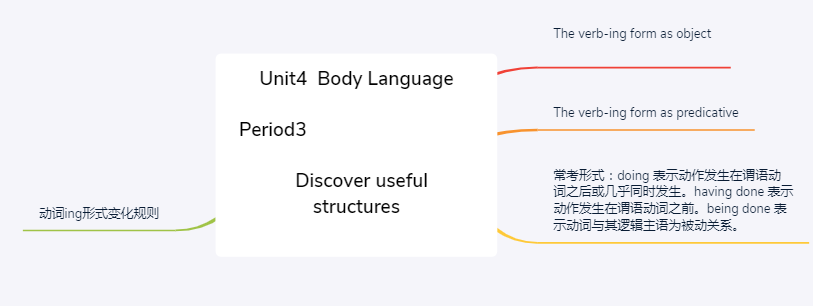
The verb-ing form as object and predicative
形式:一般式 doing being done
完成式 having done having been done
verb-ing的否定形式是在其前面加not
Step3 Study
- 1.The verb-ing form as object
- v-ing形式在句中既可以用作动词后面的宾语,也可以用作介词后面的宾语。
- 常用v-ing形式作宾语的动词有:mind, admit, practice, risk, miss, avoid, consider, enjoy, escape, finish, imagine, suggest, look forward to,insist on,set about,等。
- e.g. 1)It was fortunate that Jack narrowly escaped being killed in a traffic accident
- 2)I am looking forward to seeing you again.
- 以下及物动词后既可接不定式又可接动词-ing作宾语,但两者意义上有区别
- 用it作形式宾语,真正的宾语是动词-ing形式。其结构是:
- 常用动词有: think, like, hate, consider, find, feel, believe等
- I feel it difficult trying again.
- I found it useless/no use crying over the split milk.
- 名词宾格/名词所有格/形容词性物主代词+动词-ing形式
- Would you mind my/me opening the window?
- Would you mind Mary’s/Mary closing the window?
- 2. The verb-ing form as predicative
- v-ing形式,不强调动作,只说明动作的名称,或主语的内容或表示主语具有的特征。
- e.g. 1)The reason he gave was very convincing.
- 2)Perhaps the best example is smiling.
- doing 表示动作发生在谓语动词之后或几乎同时发生。
- having done 表示动作发生在谓语动词之前。
- being done 表示动词与其逻辑主语为被动关系。
- e.g. 1) If we are feeling down or lonely, there is nothing better than seeing the smiling face of a good friend.
- 2)Some students' favorite activity is daydreaming.
- 3) Ultimately, my duty is helping every student to learn.
- check—checking rain—raining
- 2)以不发音的-e结尾的单词,去掉字母-e,再加-ing,但是双写-ee结尾的,要直接加-ing,如:
- move—moving close—closing
- 3)以重读闭音节结尾,即“辅+元+辅”结尾的动词,先双写末尾的辅音字母,再加-ing,如:
- stop—stopping drop—dropping
- 5)以-ie结尾的动词,把-ie改为-y,再加-ing,如:
- Analyse each of the following sentences using the -ing form as the object or predicative.
- eg. We can learn a lot about what people are thinking by watching their body language.
- the v-ing form used as the object;
- watching their body language在句中作介词by的宾语, 意为“(通过)观察他们的肢体语言”。
- Tip:Pay attention to the preposition“by”.
- 1. However, you should avoid making this gesture in Brazil and Germany, as it is not considered polite.
- the -ing form used as the object,
- making…Germany在句中作动词avoid的宾语。
- 2. Elsewhere, people favour shaking hands, bowing from the waist, or nodding the head when they meet someone else.
- the -ing forms used as the object,
- shaking,bowing,nodding在句中作动词favour的宾语。
- 3. A good way of saying “I am full” is moving your hand in circles over your stomach after a meal.
- the -ing form used as the predictive,
- moving…meal在系动词 is后作表语,说明主语的内容。
- 1.Complete the sentences using the -ing form of the words and phrases in the box. Two are extra. Then state their functions.
- 1.Bill’s job is _____ sign language.
- 2. The theme of his presentation is ______ barriers between groups.
- 3.By _____, we mean “bending our head or body forward as a sign of respect or shame”.
- 4. ________ three kilometres of heavy traffic took me almost 25 minutes.
- We intended to visit the theme park but ended up ______ Professor Zhang.
- Complete the passage with the correct forms of the words and phrases in the box.
- consider individual differences
- consider the whole picture
- evaluate a patient’s condition
- Reading body language is not an easy task. It can be challenging because interpreting the signs that another person shows requires considering the whole picture.
- In this sense, it can be compared to a doctor evaluating a patient’s condition.
- Considering the whole picture is also key to reading people’s body language accurately. For example, when lying, some people avoid eye contact. By contrast, others may maintain eye contact even longer than usual.
- Talk about the body language you can read from the following pictures
- The man enjoys looking at himself in the mirror.
- The woman shows her impatience by looking at her watch.
- The boy is frightened, trying to run away from the angry dog.
- 1.The dancer’s incredible performance had the audience on its feet (clapping) for 10 minutes at the end of the show.(2020天津)
- 2.They represent the earth (coming) back to life and best wishes for new beginnings.(2020全国II)
- 3. Many museums are lively places and they attract a lot of visitors. As well as looking at exhibits, visitors can play with computer simulations and imagine themselves living at a different time in history or (walking) through a rainforest. (2020全国新高考)
- 4. In the first place, it often happens that we have trouble(finding) proper words and phrases to give expression to our mind.(2021青岛模拟)
- 5. You don’t have to run fast or for long to see the benefit. You may drink, smoke, be overweight and still reduce your risk of (dying) early by running.
- 6.I quickly lower myself, ducking my head to avoid (looking) directly into his eyes so he doesn't feel challenged.
- 7. I still remember (visiting) a friend who’d lived here for five years and I was shocked when I learnt she hadn’t cooked once in all that time.
- Many Chinese brands,(having developed) their reputations over centuries, are facing new challenges from the modern market.
| Learn the usage of the v-ing form and make notes.
Learn the difference between them
Remember the changes
Deal with the exercises in groups
- Discuss the content and know the v-ing
.
| Improve students’ the ability of
understanding and
cultivate students’
analytical and
creative abilities.
Practise
the ability
to analyze
and
solve problems
Improve the spirit of teamwork and learn to compare similar things.
| 课堂小结
| Step5:Summary:
These are what we’ve learned in this passage.
Step6 Homework
Choose a person that you are familiar with to introduce his or her common body language.
Requirement:Try to use v-ing form
(80—120 words)
| | | 板书
| Unit4 Body language
Period 3 Discover useful structures
1.She enjoys learning about body language in different cultures.
2. The crucial thing is using body language in a way that is appropriate to the culture you are in.
- 1. However, you should avoid making this gesture in Brazil and Germany, as it is not considered polite.
- 2. Elsewhere, people favour shaking hands, bowing from the waist, or nodding the head when they meet someone else.
- 3. A good way of saying “I am full” is moving your hand in circles over your stomach after a meal.
| | |
|
|
 川公网安备51152402000101号 )|网站地图


 发表于 2026-3-8 06:34:34