|
|
新人教版(2019)英语选择性必修一
Unit2Looking into the future
Period 3 Discover useful structures教学设计
课题
| Period 3
Discover useful structures
| 单元
| Unit2
| 学科
| English
| 年级
| Senior Grade 2
| 教材分析
| The topic of this unit is "Looking into the Future." And the passage is about how to learn and use the future progressive tense by observing sentences, finishing sentences about Jack’s life and making up a conversation using the tense.
| 学习
目标与核心素养
| Knowledge objectives: grasp the future progressive tense.
Skill objectives: use the future progressive tense to make predictions.
Emotional objectives: learn to understand the future progressive tense and make up conversation to make prediction to our future life.
| 重点
| Help students to use the future progressive tense.
| 难点
| To express predictions using the future progressive tense.
|
教学过程
| 教学环节
| 教师活动
| 学生活动
| 设计意图
| 导入新课
| - Observe the following sentences. One is in the simple future tense. The other is in the future progressive tense. What different impression do they make?
- 1. In the future, we will use advanced technology every day for automatic control of just about everything in our home.
- 2. In the future, we will be using advanced technology every day for automatic control of just about everything in our home.
- 3. However, in the not-too-distant future, we will be living in smart homes that will lock the door for us when we are away.
- 4. However, in the not-too-distant future, we will live in smart homes that will lock the door for us when we are away.
- 5.In addition, your smart home will be monitoring your health for you every day.
- 6. In addition, your smart home will monitor your health for you every day.
- 7.Smart toilets will be keeping constant track of your health as well.
8. Smart toilets will keep constant track of your health as well.
| Observe the sentences and find
the future progressive tense.
| Improve the
students’ the
ability to observe
and find new things.
| 讲授新课
| Step2 Conclusion
The future progressive tense
概念:将来进行时表示要在将来某一时间开始,并继续下去的动作。一般用延续性动词表示。在英语时态中,"时"指动作发生的时间,"态"指动作的样子和状态。 常用来表示礼貌的询问、请求或期待等。
形式:shall/will be doing
Step3 Study
PPT 4-10
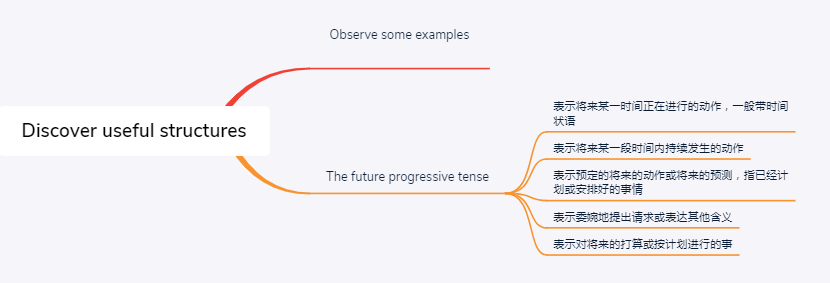
- 表示将来某一时间正在进行的动作,一般带时间状语。at this time on Sunday, by this time,tomorrow, in two days, tomorrow evening
- e.g. 1)What will you be doing at this time next Monday?
- 2)When he comes to my house tomorrow, I will be writing the report.
- e.g. 1)I shall be staying here about a week.
- 2)He will be working in Geneva during the summer vacation.
- 3) I wonder if it will still be raining this afternoon.
- 3.表示预定的将来的动作或将来的预测,指已经计划或安排好的事情。
- e.g. 1)Tomorrow I will be flying to Bombay. After you take the medicine, you will be feeling much better.
- 2)Don't call me between 12:30 and 13:00. I will be taking a nap.
- 3) Sorry, I can't meet you at five o'clock tomorrow afternoon, because I will be playing soccer then.
- e.g. 1)When will we be meeting again?
- 2)Stop the child, or he will be falling over.
- 1)I'll be working on this tomorrow.(按计划进行)
- 2)Will you be joining us for dinner?(询问计划)
- Read the passage and complete the following sentences. If you can find the answer, please stand up as soon as possible.
- Jack goes to school every weekday. He leaves home at 6:45 and arrives at school at about 7:30. His morning classes begin at 8:00 o’clock and continue until 12:15. Then he has lunch, which takes about half an hour. His classes begin again at 1:30 in the afternoon and end at 3:50. he goes to the school’s football club at 4:30 and finishes practice at 6:00. He arrives home at about 6:45. Every day he follows the same routine and tomorrow will be no exception.
- 1.At 6:30 a.m. tomorrow,…
- 2.At 8:10 a.m. tomorrow,…
- 4.At 5:00 p.m. tomorrow,…
- 5.At 6:45 p.m. tomorrow,…
- Fill in the blanks with the proper forms of the verbs in brackets.
- 1. You can call me then. I _________ (not sleep).
- 2. They set off at 9:00 a.m. and thought they _________ (reach) the airport an hour later.
- 3. Will you _______(wait) for me until I find electrical wires?
- 4. Better not hang out with Sam then. He _______ (work) on his article on critical thinking.
- 5. I guess most parents _______(support) the new plan at the meeting tomorrow.
- Answers: will not be sleeping ; will be reaching; be waiting; will be working; will be supporting
- Read the travel plan and make up a conversation using the future progressive tense.
| - Fly to Beijing from Melbourne,arrive at 10:00a.m;Visit the Summer Palace in the afternoon
| | - visit the Palace Museum;Afternoon:
| | - three hours’ drive there and back
| | - Go sightseeing in Shichahai;Visit National Museum of China
| | | | - Back to Beijing in the afternoon;Watch Beijing Opera at the Mei Lanfang Theatre
| | |
- Tips: Connect the time with the place and make sentences.
- eg. I will be arriving at 10:00 a.m
- Take the plans on Monday for example. We can begin our conversation like this:
- A: Hi, Jack. How will you spend your holiday this week?
- B: I will go to China to visit some famous places.
- A: It's great. When you come, I am glad to help you.
- B: Thank you, I’ll be flying to Beijing on the Monday morning. And I will be arriving at 10 a.m.
- A: Where will you go to visit first?
- B: I’ll be visiting the Summer Palace in the afternoon.
- 1. He (wear) a dark green suit and a yellow tie waiting for you at nine o’clock tomorrow morning.
- 2. I’m afraid I won’t be available then. I (see)
- a friend off at two o’clock this afternoon.
- 3.Daniel’s family (spend) their holiday in Huangshan this time next week.
- 4.If you plant watermelon seeds in the spring, you
- (eat) fresh watermelon in the fall.
- We (have) a meeting at three o’clock tomorrow afternoon.
- Answers:will be wearing; will be seeing; will be spending; will be eating; will be having
| Learn the usage of the future progressive tense and make notes.
Deal with the exercises in groups
Discuss the content and make dialogues in pairs
.
| Improve students’ the ability of
understanding and
cultivate students’
analytical and
creative abilities.
They can know
the different
impressions the
future progressive tense makes.
Practise
the ability
to analyze
and
solve problems
Improve the spirit
of teamwork and
the competitive
ability.
| 课堂小结
| Step5:Summary:
These are what we’ve learned in this passage.
Step6 Homework
Use the future progressive tense to describe your travel plan in the coming winter holiday.
| | | 板书
| Unit2Looking into the future
Period 3 Discover useful structures
The future progressive tense
shall/will be doing
| | |
|
|
 川公网安备51152402000101号 )|网站地图


 发表于 2026-3-8 06:36:48