|
|
Unit 1 My name’s Gina.
Section A (GF-3c)
Teaching Aims
| Learn to use the personal pronouns and possessive pronouns.
my, your, his, her, I, you, he, she, am, is, are
1. —What’s your / his / her name? —My / His / Her name’s …
2. —Are you …? —Yes, I am. / No, I’m not.
3. —Is he / she …? —Yes, he / she is. / No, he / she isn’t.
| Teaching Difficulties
| Ss are able to introduce things with proper personal pronouns and possessive pronouns.
| Teaching Aids
| multimedia courseware or other realia that the T needs for teaching
|
Teaching Procedures
| Tips
| Step 1 Warm-up
| 学生在回答问题时,教师务必用不同的评价性语言鼓励学生,无论他的回答是否让你满意
通过看图猜词,帮助学生正确使用句型。
| - Show Ss teaching goals in this class.
T: Morning everyone. Today we are going to learn to use the personal pronouns
and possessive pronouns to introduce things.
- Show Ss pictures on PPT P5-P8 and ask them to answer questions.
(If Ss can’t answer the questions correctly, T must give them guidance, and make a summary about the sentence patterns. At the same time T must give students positive comments to encourage.)
- Ask Ss to introduce their friends to their deskmate.
T: Now it’s your turn now. It’s time for you to introduce your friends to your deskmate. You can use the sentence patterns on PPT: What’s his name? S: He is … / His name is … What’s her name? S: She is … / Her name is … Is he / she …? S: Yes, he/she is. / No, he / she isn’t.
| | Step 2Grammar learning
| 本部分的语法是重难点,老师应该多引导学生自主探索或小组合作探索这些语法,从而记得更牢固。
通过思维导图让学生更容易理解和记忆这些语法之间的不同。
| - Ask Ss to read the contents on grammar focus part, and make a summary.
(T can show the questions on the blackboard like: What are the personal pronouns? Ask them to talk about the questions in groups or find out the answers in their workbook such as《学练优》. After that T can ask Ss to make a summary according to the following table.
人称代词主格

形容词性物主代词

- Ask Ss to summarize the differences of the two.
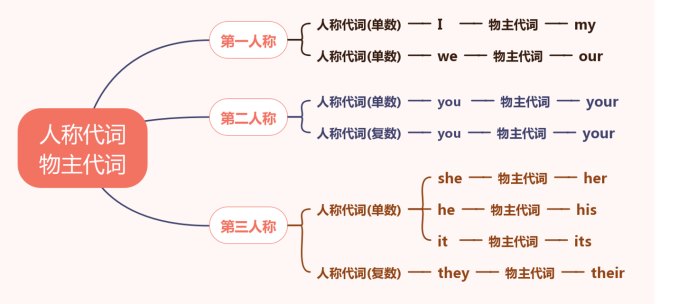
- Show Ss grammar focus part and ask Ss to answer the questions.
Q1: sentence pattern about asking for others’ names.
Q2: sentence pattern about introduce yourselves.
Q3: introduce others
(This part is easy for Ss to make a summary. And T must show the summary on PPT after Ss share.)
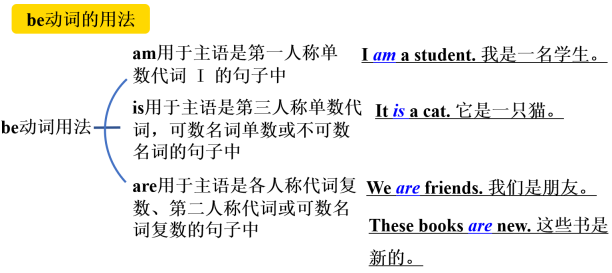
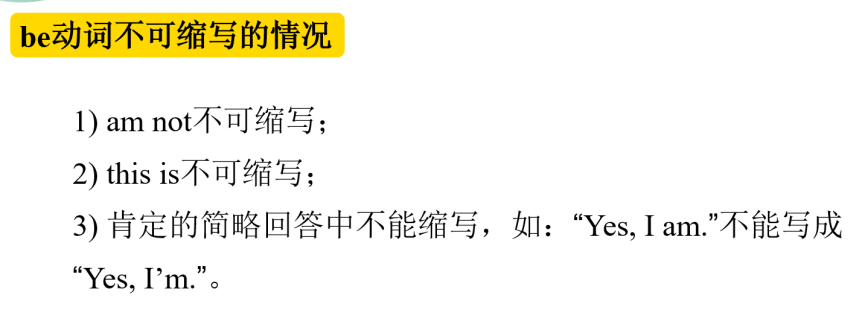
- T introduce other difficult language points to Ss.
be动词的用法
Be动词不可缩写的情况
| | Step 3Presentation & Practice
| | - Ask Ss to do the task in 3a and invite some Ss to read the conversations to check answers.
- Answers: —What’s your name? —I’m Cindy.
- —What’s his name? —He’s Bob.
- —Are you Mike? —Yes, I am.
- Ask Ss to fill in the blanks in 3b. Then Ss can check answers with partners. At last the T can choose some Ss to role-play the dialogue to make sure they get the correct answers.
- If possible, the T can ask Ss why they choose the answer. If Ss have problems, the T should explain the related knowledge clearly.
- Answers: What’s name’s are No I’m Bob Nice meet
- T can ask Ss to introduce their group members to the class.
(Ss can introduce the students in their rows or their group members. T correct their grammar mistakes while Ss are sharing. After Ss share, T ask how many students they remember. Ss who can remember the most names can get a star.)
| 通过习题让学生对知识点的用法有更加清晰的认识。
这个小组互动很有效的调动了学生积极性帮助他们练习句型,同时培养他们的瞬间记忆能力。
| Step 4 Summary & Homework
| 通过习题让学生对知识点的用法有更加清晰的认识。
| Summary
Ask Ss to do the exercises on PPT P23-P26.
T ask Ss to make a summary about language points they learned today.
Homework
1. Preview the new words and phrases in Section B(1a-1e).
2. Do the exercises in students’ book.
| | Teaching Reflection
| Personal pronouns and possessive pronouns are difficult points in U1, especially for Ss who have weak sense of English. Dictation must be done in the next class to make sure students can memorize all the pronouns and use them correctly. The class procedure is simple, and T must pay more attention to their mistakes in exercise.
|
|
|
 川公网安备51152402000101号 )|网站地图


 发表于 2026-3-2 05:58:56